| News
Financial and Executive Disputes Between the Two Governments… Hammad Calls for Addressing the Remaining Files
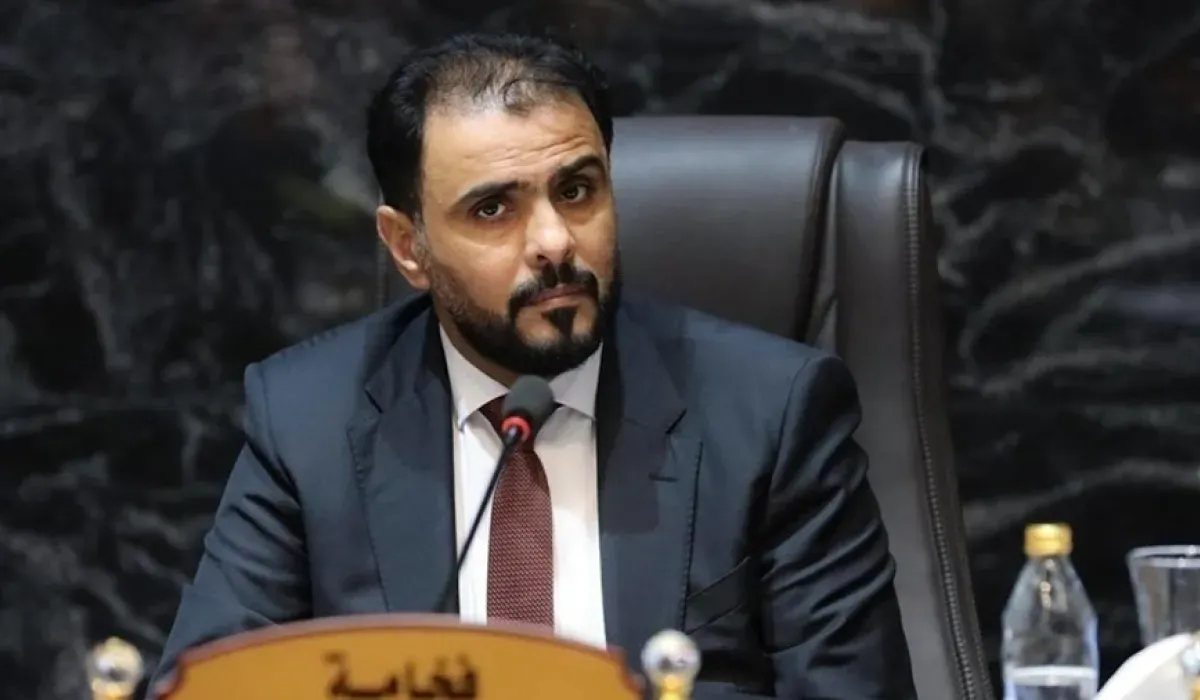
Libyan Prime Minister Osama Hammad stated that the head of the Government of National Unity, Abdul Hamid Dbeibeh, is attempting to mislead public opinion and is blackmailing sovereign and financial institutions to obtain funding outside the framework of the law.
He added that Dbeibeh speaks about public debt in a contradictory manner—acknowledging it at times and denying it at others—affirming that what is being circulated is not public debt but rather “accounting debt.” He explained that public debt occurs during the term of a legitimate elected government, such as the General National Congress headed by Abdullah Al-Thinni.
Hammad clarified that there is an executive dysfunction between him and Dbeibeh, pointing to the continued annual spending and the increase in reconstruction and development allocations without citizens seeing tangible results on the ground.
He stressed that Dbeibeh is in violation of all legislation and that everyone will be held accountable, adding: “Even if we approved public debt, it was done in accordance with the law, and we are spending according to a financial rule.”
Hammad reassured Libyans that the Central Bank of Libya confirmed that general reserves are increasing rather than declining, according to the testimony of the bank’s Board of Directors. He noted that they attempted to address the situation and held meetings with Dbeibeh to reach a solution.
He also indicated that all court rulings support his government, affirming that they remain in place and hope Dbeibeh will adopt a single approach to resolve the remaining files.
Hammad added that responsibility for the public debt lies with all parties, explaining that his government has reconstructed several areas in Libya, including Sirte and Murzuq. He noted that during negotiations with former Central Bank Governor Al-Siddiq Al-Kabir, a unified budget law was approved, allowing Dbeibeh to spend legally.
He further explained that his government has been marginalized in terms of resources, as all resources are concentrated in Tripoli, stressing the need to find a solution and begin imposing a de facto situation.
Hammad stated that the total expenditures of Dbeibeh’s government over five years amounted to 826.4 billion dinars and is expected to reach one trillion dinars in 2026. He added that there is an amount of $35 billion allocated for fuel swaps, equivalent to approximately 200 billion dinars depending on exchange rates, noting that this issue is currently with the Public Prosecutor’s Office.
Hammad concluded by saying that a law was established to maintain the public debt in Libya through the Central Bank’s Board of Directors, to be written off by the House of Representatives.