Tag: banks

Mrajaa Ghaith to Sada: “Banks Have Shifted from Credit Institutions to Mere Currency Sellers”

Former member of the Board of Directors of the Central Bank of Libya, Mrajaa Ghaith, said in an exclusive statement to our source that even if the Central Bank were to inject all of its reserves, the dollar would fall and then rise again a week later, because demand for the dollar is informal. “We have invisible demand. Some are willing to buy the dollar even at 50 dinars, among them smugglers, arms dealers, terrorists, human traffickers, and drug smugglers. They have no problem at all. Any dollar put on the market, they will take it at any price. The dollar problem in Libya is not linked only to the Libyan state, traders, or Libyan users. This is organized crime at a global level, not limited to Libya. If it were only the Libyan traders’ issue, the problem would have been solved. Therefore, these are not pressure measures, but monitoring measures on how the dollar is used, where does it go?”

Ghaith questioned what are referred to as “personal purposes,” asking whether Libyan citizens actually travel for tourism. He answered that very few do so; some travel for medical treatment. “Today, almost all Libyans have a personal-purpose card; once a child is born, a card is issued and then sold to black-market traders. This must end through a different approach. The approach we currently see as appropriate is to allow banks to provide cash dollars to a number of citizens who genuinely need them. Citizens cannot withdraw large amounts anyway; even globally the limit is around $4,000 or $5,000—this is not an issue. But today we have thousands of cards, each with $4,000, amounting to four million cards. Where does this money go? It is smuggled abroad. We all heard the story that happened in Turkey.”

He continued: “God willing, this chaos will end at this level, because these operations, according to international investigations, are reopened after 20 years, and banks are questioned about them after 30 years. I have reviewed files where investigations were reopened after thirty years due to suspicions of money laundering. This is not a matter of a day or a month.”

Ghaith explained that these practices are what led to the emergence of the black market. “The issue is economic, not security-related. Closing Al-Mushir market does not end anything, because the black market exists in WhatsApp rooms in Dubai or Istanbul. They trade prices every morning via their phones. The solution is economic, not security-based. You can stop small players dealing in thousands, but major traders dealing in millions are impossible to stop. The real market is not in Al-Mushir; it is in WhatsApp rooms.”

He added that the crisis is one of trust between depositors and banks, because banks no longer provide services that benefit them. “Small traders ask: why should we put our money in the bank when we cannot withdraw it and have to buy from the black market? This is a point the Central Bank must pay attention to. ‘Zero cash’ is a dream—we are still a cash-based society. People naturally prefer cash because it gives them reassurance when their money is in front of them. We hope to achieve a 50/50 balance between cash and banking services, and the entire role then falls on banks to attract customers. Attraction comes through improving services, offering benefits and incentives, and bearing part of the costs in the early years, as happened in Egypt.”

He continued: “I do not fully blame banks, because they went through a difficult phase and are no longer just banks; they became salary treasuries. Today, asking them to make a 180-degree turn and become like global banks is difficult. This transformation needs 10 to 15 years for proper banking culture to develop among people and for systems and services to evolve.”

The former member of the Central Bank of Libya’s Board, “Mrajaa Ghaith,” concluded his statement to Sada by saying: “Banks have shifted from institutions with a credit role to merely selling currency. Their services have become focused on letters of credit and personal allocations. We hope banks return to their true role.”

From Banks to Foreign Investments… Prosecutors Uncover a Corruption Network Exceeding 25 Million Dinars and 22 Million Euros

Publications by the Office of the Attorney General on its official Facebook page in recent weeks have raised many questions about the involvement of several officials in harming public funds, including illegal financial transfers and embezzlement of public money—behaviors that reflect a lack of responsibility and professional integrity.

The reach of corruption was not confined to the domestic sphere, but extended to foreign investments as well.The spree of theft in Libya was not limited to men alone; women were also implicated in major corruption cases. A female official in the Accounting Department at the Republic Bank’s Branch Administration in Tripoli was arrested for embezzling 13 million dinars from the bank. She was followed by another employee who seized 2 million and 578 thousand dinars.Accusations also reached the Assistant Director of the Republic Bank branch at the Libyan Academy for Postgraduate Studies, who embezzled 998 thousand dinars. Additionally, an employee at the Republic Bank’s Qadisiyah branch was detained after embezzling 8 million and 255 thousand dinars.

The Public Prosecution also charged a defendant involved in forging unofficial documents, along with four employees who neglected their duties, enabling others to carry out the embezzlement operation.The chain of investigations continued, leading to a decision to detain the Chairman of the Board of Directors of the National Development and Investment Holding Company, its General Manager, and project management officials, after they caused the failure to collect 6 million and 457 thousand dinars and inflicted severe damage on the company due to the purchase of a property later found to be located within the route of the Third Ring Road—resulting in its complete demolition.The corruption cases extended beyond the country’s borders as well. The Public Prosecution ordered the detention of the General Manager of the Libyan Foreign Investment Company’s branch in the Republic of Mali over financial and administrative violations in the project to rehabilitate Hotel Africa, which resulted in the disposal of 22 million euros in violation of approved regulations.At the end of last week, another case emerged: the detention of a former General Manager of the National Investment Company under the Ministry of Finance, along with a former Director of the company’s Investment Department, for spending funds outside the purposes of investment—amounting to 55 million and 648 thousand dinars of the company’s money.

Al-Sharif: “Corruption in Banks Is Just a Small Part of a Much Larger System Eating Away at State Institutions”


Economic Expert Idris Al-Sharif wrote:

“In recent days, cases of financial misconduct and corruption in Libyan banks—revealed by the Office of the Attorney General—have multiplied. I will not repeat what many scholars and specialists have already written about the causes behind the spread of this phenomenon.

However, I would like to emphasize that corruption in the banking sector represents only a small portion of the widespread corruption permeating all state bodies, ministries, and institutions—indeed, perhaps the smallest part by far!

The difference is that banks, by the nature of their work, are more disciplined from an accounting standpoint compared to other administrative institutions, and their funds are (private), which makes it easier and quicker to uncover violations and irregularities.

Although the Constitutional Declaration grants the Audit Bureau—under Article 28—the authority to exercise financial oversight over all revenues, expenditures, and movable and immovable assets owned by the state, ensuring their proper use and protection,

more than two-thirds of current public spending remains outside any form of audit or financial supervision! This includes spending by high sovereign authorities such as the House of Representatives, the High Council of State, the Presidential Council, and judicial, regulatory, security, and military bodies, as well as some executive institutions.

These entities have exempted themselves from financial review—either through tailor-made legislation serving their own interests or simply by the force of reality.

Undoubtedly, the hidden part of the corruption iceberg is far larger than we imagine. Yet we can clearly feel and observe its effects on the economy, on living standards, and in the emergence of social stratification and unjustified disparities in income levels among citizens.”

Helmi Al-Gmati: “These Are the Reasons Behind the Cash Shortage Crisis in Banks”

Economics professor Helmi Al-Gmati wrote: The quarterly data issued by the Central Bank of Libya up to June 30, 2025, indicate that the cash shortage crisis in commercial banks is not due to a scarcity in the total money supply, but rather to a structural imbalance in the components of the monetary base (Currency with Public + Bank Reserves) — meaning in the distribution of liquidity between the public, banks, and the Central Bank.

Since 2014, there has been a continuous decline in the ratio of currency in circulation to total bank reserves at the Central Bank (C/R), dropping from levels above (1.4:1) to below (0.8:1) during 2025. This decline coincided with:
• Raising the legal reserve ratio from 20% to 30%.
• Increasing the volume of additional deposits held at the Central Bank, bringing their total to nearly 50% of bank deposits.

These developments led to an effective contraction of liquidity available within the banking system, despite the overall monetary base remaining almost unchanged, as a large portion of liquidity shifted from circulation to frozen accounts within the Central Bank.

Practically speaking, the withdrawal of currency denominations (1, 5, 20, and 50 dinars) and the reissuance of a smaller-value currency (25 billion compared to 47 billion withdrawn) reduced the monetary base by about 22 billion dinars. According to calculations of the money multiplier, the money supply decreased by approximately 23.3 billion dinars as a result of the contraction in B and the rise in rr.

Based on these indicators, the liquidity shortage in banks is due to:

  1. The increase in both legal and additional reserve requirements (cash held at the Central Bank).
  2. The drop in the ratio of currency in circulation to reserves to below (1.1), restricting cash flow into the market.
  3. Mismanagement of the withdrawal and reissuance of currency, lacking balance between amounts withdrawn and injected.

It is expected that injecting an additional 14 billion dinars before the end of 2025, and 21 billion during the first quarter of 2026, will raise the ratio to around (1.6:1), which is likely to restore balance to the monetary base and gradually ease the liquidity crisis.

In conclusion, Libya’s liquidity crisis is the result of a structural imbalance in the distribution of the monetary base, not its total size. The accumulation of reserves at the Central Bank alongside the decline in currency circulation has reduced the effective liquidity available to the public. Therefore, restructuring the components of the monetary base and adjusting the legal and optional reserve ratios represent the key steps to restoring monetary stability and improving the efficiency of monetary policy.

Exclusive.. Central Bank: Clients will be notified via SMS upon approval of executed letters of credit.. Results to be announced by end of business today

The Central Bank of Libya revealed exclusively to our source that the Accounts Department has begun executing and selling USD 1.7 billion to banks to cover letters of credit, in addition to granting new approvals worth USD 2 billion.

It confirmed that bank clients will receive an SMS notification once their letter of credit is approved — a step that facilitates suppliers in obtaining information and communicating with their banks. The results of today’s operations (Wednesday) will be announced by the end of the working day.

Al-Zantouti Writes: “Dollar Accounts for Libyan (and Other) Depositors in Our Local Commercial Banks… Why Not!!”

Financial analyst Khaled Al-Zantouti wrote in an article:

I have asked several times why individuals and institutions are not allowed to open dollar accounts in Libyan banks, but I have not found a clear answer. My question here is: does the law permit it? And if it does, then why don’t our commercial banks provide such accounts? What I know is that dollar accounts exist for companies and institutions only at the Foreign Bank, and perhaps with little or no returns.

I would bet that many Libyans hold dollar accounts and accounts in other currencies in many countries around the world! I would also bet that they amount to tens of billions—perhaps more. I mean those accounts created abroad for reasons of work, study, trade, commissions, and so forth. These have effectively become clean, legitimate funds, even if some were once questionable—since they are held in banks in many foreign countries, that means they are considered legal money, even if not originally.

The point is not to investigate why they are abroad, but rather to ensure they are present inside the country, in accounts free of restrictions on movement and with rewarding returns. Repatriating and transferring these billions into national commercial banks would completely change our economic equation. The supply of dollars would be large, giving commercial banks the chance to re-lend them in various forms of credit facilities, including opening import letters of credit! In addition, this could positively affect the dinar’s exchange rate—why not? Especially when Libyans currently receive the lowest returns, and sometimes even negative returns (as happened in some European banks with the euro in recent years). So why not encourage Libyans to move their external accounts home, with banks granting them attractive returns—perhaps through Islamic sukuk, dollar-denominated certificates of deposit, or similar instruments—with returns higher than abroad? In turn, banks would use these funds in well-studied, guaranteed lending to national companies or even individuals, in line with the banking role of pooling small depositors’ savings.

This would also enable us to issue dollar-denominated bonds through the public treasury if dollar financing were needed—even without a credit rating for Libya. They would simply be local dollar bonds (or sukuk) backed by government guarantees!

We in Libya deserve to have our dollars in our own banks, not in Switzerland, Turkey, Tunisia, or even London. These countries open their banks to our citizens’ money yet deny us the right to keep our dollar funds in our own banks! And if some of this money was once illegal, the fact that it is accepted abroad makes it legal and clean!

So, if the law in our country allows it, we should start designing programs to attract these funds and encourage Libyans to transfer them into our local banks under familiar mechanisms of financial transfers, with the Central Bank smoothing all obstacles to make this possible. And if it is not legally permitted, then it must be legalized and allowed without any barriers, as soon as possible!

At the same time, I see no logical reason why Libyans with such accounts would refuse to move them home—keeping the same currency, free of movement restrictions, and with more rewarding returns than abroad. In the end, this is a national stance to strengthen the economy of our homeland.

Al-Zantouti: “Gold Hoarded in Libyan Homes as Collateral for Limited Bank Lending”

Financial analyst Khaled Al-Zantouti wrote:

While reviewing global stock, bond, and commodity markets this morning, I noticed the significant rise in gold prices over recent years—about 150%—while some global stock markets rose at lower rates, though exceptions exist (for example, the S&P 500 rose roughly 170% over the past ten years). Without diving into detailed numerical analysis, these figures show the importance of gold as a safe haven for investors, especially during times of political, military, and economic instability. The futures market and recent price developments further confirm this.

This made me think about the gold hoarded in Libyan homes, its current value, and ways to benefit from it. For reference, the average price of gold per gram in Libya was around 10 LYD in 1990 and about 15 LYD in 2000. Today, the average price is around 500 LYD per gram—50 times higher than in 1990 and 35 times higher than in 2000. This far exceeds the depreciation of the dinar against the dollar. Considering the cost of traditional gold ornaments for weddings, which previously weighed at least 200 grams (worth about 2,000 LYD then), their current value is around 100,000 LYD—a massive capital gain.

I realized that most Libyan households hold some gold—ranging from tens or hundreds of grams to kilograms—which represents an untapped economic potential, often used only for decoration or display at weddings and special occasions. The question is: why not use it economically?

I came up with a simple idea—perhaps imperfect: what if these stored quantities of gold were used as collateral for limited bank lending? Banks could lend to customers against gold held in their homes, allowing clients to fund small productive projects or housing loans.

I therefore call on the Central Bank of Libya and all commercial banks to explore a model for lending for housing and small projects using gold stored in homes as collateral, with zero risk appetite and limited lending costs. This could be a step toward secured, limited credit—especially given current conditions and the inability to fully implement the real estate registry.

Exclusive – Al-Ghaziwi: Banks’ Participation in Distributing Insurance Policies Is a Missed Opportunity in Libya!!

Akram Abdullah Al-Ghaziwi, Deputy General Manager of Takaful Insurance Company, told our source:
“In many countries around the world, banks play a key role in marketing and selling insurance policies. This integration between the banking and insurance sectors is known as Bancassurance. Despite the global success of this model, Libyan banks remain outside this partnership framework, missing out on multiple economic opportunities.”

He added, posing a question:
Why Bancassurance?
“The bancassurance model provides insurance services through bank branches, making insurance products more accessible, raising insurance awareness in society—thanks to the high level of trust banks enjoy—and helping insurance companies reduce distribution and direct selling costs.”

According to Al-Ghaziwi, both sides benefit from this model:

Benefits for banks:

  • New income sources through policy sales commissions.
  • Deepened customer relationships by offering integrated financial solutions.
  • Improved image of the bank as a comprehensive financial services institution.

Benefits for insurance companies:

  • Broad and structured customer access through banking branch networks.
  • Improved insurance penetration in the market.
  • Reduced operational costs associated with direct sales.

He also stated:
“The challenges in Libya lie in the absence of a legislative framework that allows this collaboration, a lack of insurance awareness within banking institutions, and the need to train bank employees to market insurance products.”

A Call for Change…

  • A call to the Central Bank of Libya and legislative authorities to explore the possibility of organizing this type of partnership.
  • A proposal to form joint committees between insurance companies and banks to develop a suitable mechanism for cooperation.
  • The inclusion of a pilot model with one bank to assess the feasibility of bancassurance in the market.

Wali: “Withdrawing Some Banknotes from Circulation Is a Step in the Right Direction and Has a Direct Impact on the National Economy”

Economist Ibrahim Wali wrote an article in which he stated:
The Banking Sector Between Past and Present:
Economic reform policies must be based on implementing the policy of economic liberalization, under which the market’s role in directing economic activity is activated, along with restructuring public sector institutions on investment-based foundations. This would, in turn, lead to economic stability in Libya and provide a favorable climate for the flow of both foreign and domestic investment into the country.

All of these matters are reflected in the banking system, which we are currently in dire need of developing in all its forms, due to the administrative and financial issues it faces, as well as the severe shortage of trained human resources. Therefore, I saw the need to discuss with you through this paper a central issue among the most important facing the banking sector in our beloved Libya — the issue of privatizing public sector banks. It is a mechanism whose importance is undisputed both locally and globally due to considerations of efficiency, competition, boosting self-capacity, and contributing to raising the efficiency of the economic and financial sectors to achieve high development rates, thereby achieving the goal of comprehensive development of the Libyan economy.

Although there are some reservations from notable public and economic figures known for their competence, these reservations have raised issues related to how the five local public commercial banks at that time played an outstanding national role in maintaining the stability of the national economy for a long period since their nationalization or “Libyanization” and their handover to Libyan national giants in the banking industry, such as: Rajab Abdullah Al-Maslaty, Faraj Qumra, Abdullah Ammar Al-Saudi, Bashir Al-Zuqni, Ibrahim Al-Halawi, Abdul Qader Al-Raqi’i, Hammouda Al-Aswad, Al-Hadi Al-Jitili, Jumaa Saeed Jumaa, Mohamed Ibrahim Hammouda, Ayad Al-Sayed Daheem, Mohamed Hassan Al-Nahaissi — may God have mercy on those who have passed and grant long life to those still among us — and many honorable nationalists whose names escape my memory. I urge you to mention them in the comments so the current generation in banking can recognize them.

From that time until 2011, these banks were a haven for all investors and savers in Libya — small and large, individuals and companies, and even strategic factories founded by the previous regime that ended and collapsed due to mismanagement and theft — all of which had been supported by national Libyan banks.

Libyan public banks have always been the most stable and secure throughout the years prior to 2011 and were not subjected to fluctuations or losses, thanks to the efforts of their national employees at the time and their expertise, which maintained the lowest possible level of national economic stability — especially during the unjust embargo imposed on us by the most powerful nations, namely the United States of America and the United Nations, which lasted for nearly eight years. During that period, the Libyan banking system managed to preserve Libyan reserves, evade freezing procedures, and save our beloved nation from the specter of famine, poverty, and disease — unlike what happened in other countries like Iraq.

In addition, we were able to recover the Libyan people’s frozen assets during the embargo through international courts. Thus, the Libyan banking system — with the help of the Libyan Foreign Bank’s network of branches in most countries of the world and its international banking relationships — was able to reduce the impact of the economic blockade imposed on Libya by offering banking facilities, strengthening letters of credit, and providing guarantees for commercial banks and institutions owned by Libya at home and abroad, preserving Libyan funds and ensuring the flow of food and industrial commodities and raw materials, which sustained the continuity of banking services for the national economy at minimal cost.

The Libyan banking sector was not only cautious about the privatization of some public banks because of its important economic role at the time, but also due to the national role played by public banks in Libya, where they carried the unjust historical burden caused by the nationalization of private establishments and institutions in 1987 — at that time, the private sector was the second wing of the national economy after the public sector.

These banks supported various sectors of the national economy and often stood by many national institutions, projects, and strategic factories that faced collapse due to administrative corruption and inefficiency, by injecting new capital into them and restructuring them so they could recover and benefit the national economy. Such efforts may not be possible for private banks due to limitations related to their deposit base or capital size.

Furthermore, public banks in Libya played a vital social role. The support provided by the public banking sector contributed to funding research centers, hospitals, knowledge institutions, and cultural and social centers, reviving many research and health projects that would not have existed without this public banking support. The five public sector banks, along with the Central Bank of Libya, the Libyan Foreign Bank, and specialized banks, were a model of patriotism and dedication to serving the homeland and its citizens.

The fierce struggle and legitimacy crisis between governing bodies in Libya did not stop at mismanagement and corruption in the administration of the country, but extended to the banking sector, whose latest victims include public sector banks, the Central Bank of Libya, the Libyan Foreign Bank, and other specialized banks — all now entangled in the legitimacy struggle between competing political bodies, torn apart by foreign agendas and internal obstinance.

After the banking sector had remained for years under unified management and away from the whirlpool of divisions and conflicts, our national economy must now be assigned a new and precise strategy developed by highly competent experts to restructure the economy in order to increase competitiveness, transfer technology and knowledge, and operate efficiently and effectively as expected by the Libyan citizen. The revival of our beloved Libya’s youth and economic strength lies in a banking sector capable of financing reconstruction projects, factories, housing units, and other infrastructure as needed. Banks are the beating heart of this economy, and clinging to outdated banking frameworks is like renewing the body of the national economy but leaving its heart diseased — if we do not train and develop the youth on modern banking technology and industry, this economy will continue to suffer with a sick heart.

What is the state of Libyan banks today?
A failed monetary policy — due to the lack of integration and overlap between monetary, fiscal, and trade policies — has caused the collapse of the Libyan dinar. Temporary and fragile reforms were implemented, as if in a test lab, without proper study and with patchwork solutions. As a result, the national economy now suffers from the two gaps: the public budget deficit and the balance of payments deficit. The specter of inflation will return to haunt the economy once again. If the three policies do not integrate, the economic situation will worsen and deteriorate further, bringing back the chaos of banks, corruption, liquidity crises, and the humiliation of Libyans and their women in bank queues.

As for withdrawing some denominations from circulation, it is a step in the right direction and has a direct impact on the national economy in general and on monetary policy in particular. However, the Central Bank of Libya must address the serious negative aspects related to this process, which include:

  1. Some profiteering traders involved in illicit activities (dirty money laundering) — from drugs, contract fraud, bank deposits manipulation, credit manipulation, bribery, embezzlement, commercial fraud, currency counterfeiting, and other illegal sources — may take advantage of the withdrawal process to deposit these funds into their accounts. Are the risk and compliance departments in the banks and in the Central Bank ready to implement legal procedures to detect and deter these profiteers?
  2. These profiteers may resort to buying hard currency from the black market in order to exchange or sell the withdrawn denominations. This would lead to increased demand for foreign currency in the parallel market, just as happened with the 50-dinar note, where the Souq Al-Mushir became filled with sealed boxes of currency in plain view of market visitors, the Central Bank, and even under its own wall. This would lead to a depreciation of the national currency against the dollar and other currencies, and the consequences would be dangerous.
  3. It is necessary to print between 30 to 40 billion dinars or the equivalent value of the withdrawn denominations to replace them, so citizens do not experience a shortage in liquidity.
  4. I also advise the Central Bank of Libya to allow low-income citizens who have saved small amounts at home — for medical treatment, purchasing a vehicle, or any special occasion — and deposited these amounts in their bank accounts, to receive full refunds of these amounts directly or shortly after depositing them. These amounts could range between 10,000 and 40,000 dinars, for example.

Exclusive: In the Millions… Central Bank Sanctions Three Banks for Deducting Fees from Customers and Orders Refunds

Our source at the Central Bank of Libya revealed in an exclusive statement that UBCI, Aman Bank, and the Libyan Islamic Bank are facing penalties today, following in the footsteps of Jumhouria Bank.

The source stated: The Central Bank of Libya is punishing the three banks and compelling them to return amounts deducted from customers’ accounts due to various violations, imposing strict sanctions. The banks are: UBCI, Aman Bank, and Libyan Islamic Bank.

He added:

  • Aman Bank — more than 30 million dinars
  • UBCI — around 5 million dinars
  • Libyan Islamic Bank — around 1 million dinars

He explained that these penalties were based on complaints from citizens and followed inspection tours conducted by the Department of Bank and Currency Supervision.

Exclusive.. Central Bank Instructs Commercial Banks to Take All Necessary Measures to Postpone Deduction of Any Installments from Bank Customers During the Current Month of May

Our source has exclusively obtained a correspondence from the Central Bank of Libya regarding its instruction to banks to take all necessary measures to postpone the deduction of any installments related to obligations on bank customers during the current month of May.

This includes salaries and the wife and children’s grant, in line with the Central Bank of Libya’s direction to support citizens across all segments.

image 2025 05 23 121318509

Exclusive.. Central Bank Extends Official Working Hours at Bank Branches and Calls for Increasing Service Windows and Sufficient Number of Tellers at Branches and Agencies

Our source has exclusively obtained a circular from the Central Bank of Libya, in which it announced the extension of official working hours at bank branches on the occasion of the upcoming Eid al-Adha, until 5:00 PM, starting from May 25, 2025, until June 15.

According to the Central Bank, Friday, May 30, and Saturday, May 31 will be regular working days for the current accounts and treasury departments.

The Central Bank also called for increasing the number of service windows and ensuring a sufficient number of tellers at branches and agencies, in order to give bank customers adequate opportunity to withdraw cash, and to continuously supply ATMs with the required cash across all regions of the country.

The Central Bank emphasized the need to ensure cash availability at all times to meet the basic needs of bank customers and to alleviate the burden on citizens.

image 2025 05 23 120451140

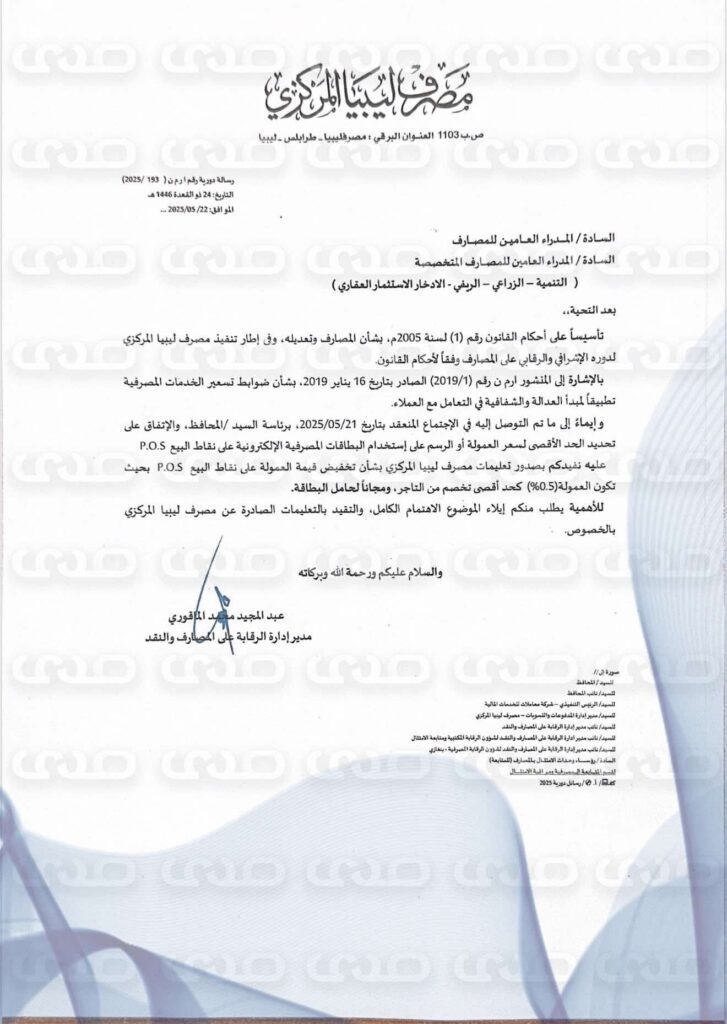
Exclusive: Central Bank Circulates Instructions to Banks on Reducing POS Commission to 0.5%

Our source has exclusively obtained a circular from the Central Bank of Libya in which it instructed banks to reduce the commission rate on Point of Sale (P.O.S) transactions.

The commission shall be set at a maximum of 0.5%, to be deducted from the merchant, starting from May 25, 2025, until June 15, and will be free of charge for the cardholder.

image 2025 05 23 115633572

Several Commercial Banks Announce Partial Civil Disobedience in Protest Against Security Breakdown and Lack of Protection

Following recent events in the country, Wahda Bank announced it will enter into partial civil disobedience starting Saturday, May 17, 2025. The decision includes the full closure of all branches located in areas classified as unsafe and the suspension of all in-person banking services in these affected areas until further notice. The bank will continue offering digital banking services as much as possible to ensure essential transactions for citizens without compromising employee safety.

According to the bank, this decision was made out of necessity and concern for the lives of its employees and the safety of its institutions, after the failure of the relevant authorities to provide the required protection, despite repeated warnings and official communications.

The bank held the official authorities fully legally and morally responsible for the daily risks and threats facing the banking sector. It also reaffirmed that the bank will not compromise the safety of its staff or depositors’ funds amidst the ongoing security breakdown.

In a related development, Mediterranean Bank also issued a statement announcing an immediate entry into partial civil disobedience, including the closure of branches in unstable security zones and the limitation of services to remote digital channels to fulfill urgent customer needs. The bank issued an urgent call for responsible authorities to fulfill their legal and ethical duties in protecting institutions and citizens. It stressed that this decision is not aimed against the state or the people, but rather a warning cry and a clear rejection of the suspicious silence surrounding the current situation.

Likewise, Bank of Commerce and Development declared partial civil disobedience to protect the safety of employees and clients amid deteriorating security conditions in several areas and the increasing frequency of assaults and violations targeting workers in national institutions, including the banking sector.

The bank emphasized that this decision does not reflect an abandonment of its responsibilities, but stems from its commitment to the safety of its staff and the public, amidst a clear absence of state protection for sovereign institutions. It called on all official entities to assume their responsibilities and fulfill their legal duty in protecting banks, considering them a pillar of the state’s stability and financial security.

Exclusive: Including a Maximum 7% Expansion in the Financing and Investment Portfolio – Central Bank Issues Key Instructions to Banks

Our source has exclusively obtained circulars from the Central Bank of Libya addressed to banks, aimed at ensuring the stability and strengthening the resilience of the banking sector, particularly in terms of influencing the volume, type, and duration of credit and financing, in a way that meets the actual needs of economic activity in production and services.

The instructions state that the maximum allowable expansion in the size of the credit portfolio – the financing and investment portfolio – for the financial year 2025 shall not exceed 7% of the bank’s existing portfolio balance. Furthermore, banks must adhere to the instructions when granting credit and financing, which must be based on a thorough study of the client and the associated risks, and must include all the requirements stipulated by the Central Bank of Libya.

It is also necessary to review, update, and develop credit/financing and investment policies, as well as related risk management policies, to keep pace with market changes and economic conditions. These policies must at least meet the minimum requirements set by the Central Bank of Libya.

Banks must also manage the credit/financing and investment portfolio in a way that reduces the ratio of non-performing loans and limits individual and sectoral concentration. The portfolio should be diversified by setting limits to address concentration risks across various levels and activities.

Periodic review and updating of standards and conditions related to granting credit and financing must be conducted whenever necessary, in order to avoid any future risks to the banks.

In addition, efforts must be made to train and qualify staff in managing credit/financing and investment portfolios, and in applying best practices in risk management, by enrolling them in certified and specialized training programs to enhance their competencies.