The Central Bank of Libya told our source exclusively: “As part of its commitment to fairness and equal opportunity among suppliers of goods and services, an electronic system will be launched starting in early August to accept letters of credit applications through banks. This system will allow suppliers to submit their requests digitally, and the applications will be processed based on date and order of submission.”
The system will also enable the Central Bank to monitor and audit transactions until the currency purchase process is completed through the Central Bank. The bank will announce and introduce this system soon.
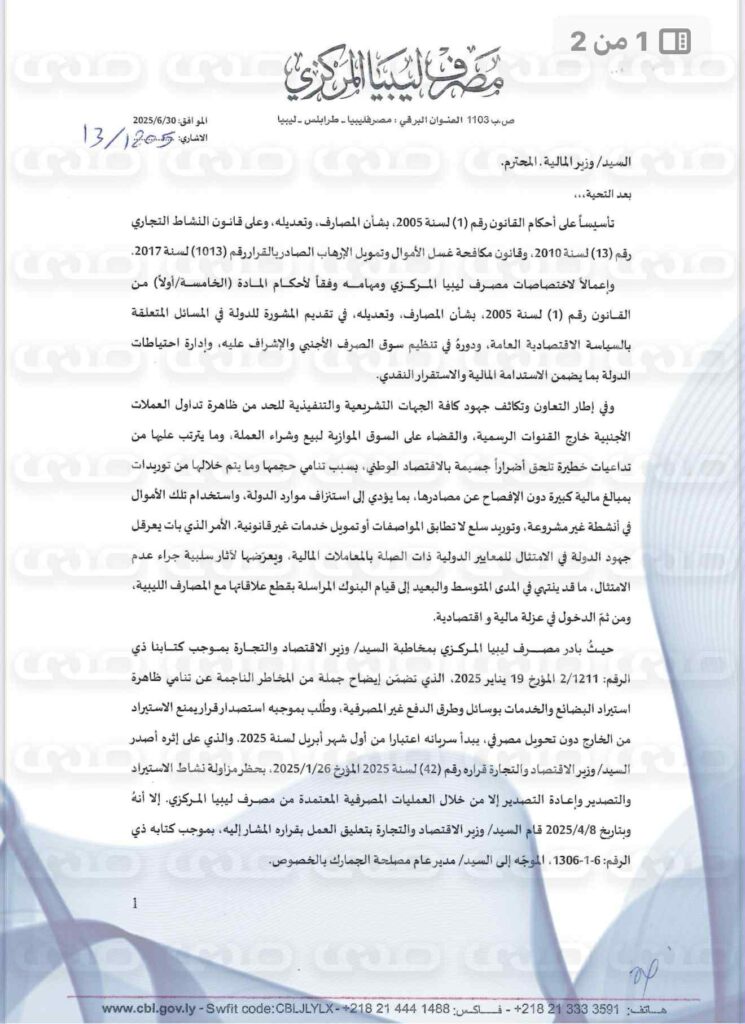
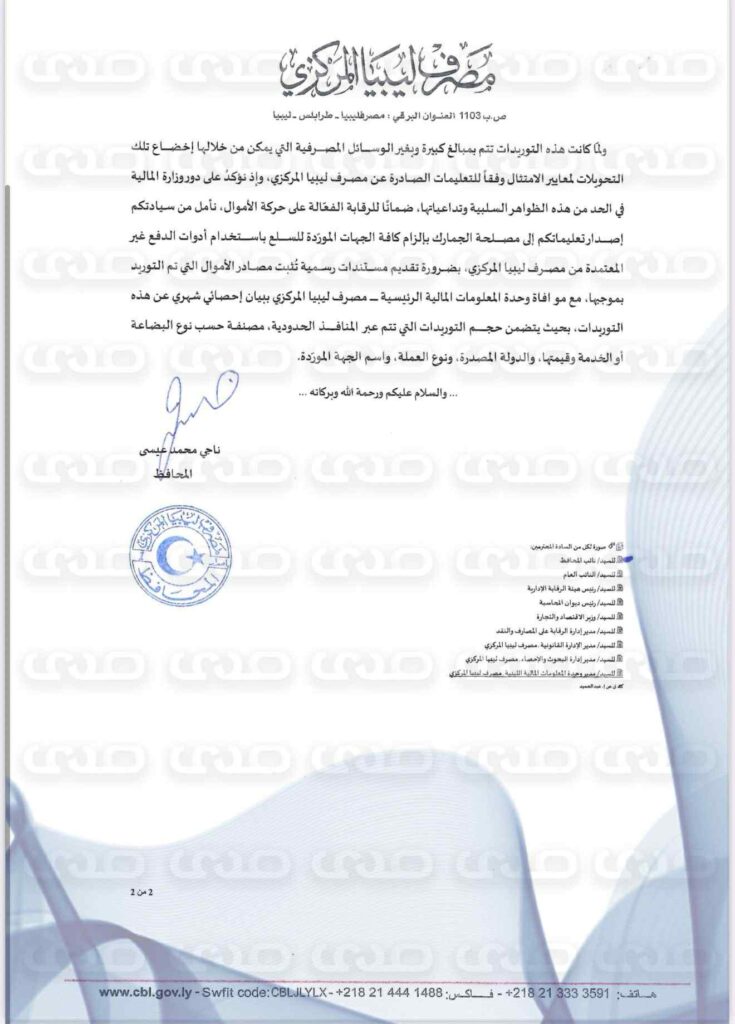
Our source has exclusively obtained a letter from the Governor of the Central Bank of Libya addressed to the Minister of Finance of the Government of National Unity. The letter requests the issuance of instructions to the Customs Authority obligating all suppliers using payment tools not approved by the Central Bank of Libya to submit official documents proving the sources of the funds used for the imports.
Additionally, the letter calls for the provision of a monthly statistical report to the Central Bank’s Financial Information Unit detailing these imports, including the volume of imports passing through border crossings classified by type of goods or services and their value, the exporting country, currency type, and the name of the supplying entity.
Our source has exclusively obtained a letter from the Governor of the Central Bank of Libya regarding his instructions to banks and licensed exchange offices and companies. The directive authorizes banks to open foreign currency-denominated accounts for exchange offices and companies that have been granted operating licenses by the Central Bank of Libya to conduct their activities. These accounts will be funded with foreign currency by the Central Bank of Libya and any other sources approved by it.
The Governor also emphasized the necessity of adhering to the regulations and instructions issued by the Central Bank of Libya and the requirement to provide all necessary documents for opening accounts in accordance with the provisions of Circular Number (2009/13).
According to the letter, in addition to the operating license granted by the Central Bank to the company or office, banks may provide exchange companies and offices with Point of Sale (POS) devices to accept international cards, based on the strength of their open accounts for the purpose of purchasing foreign currency. Deductions from cards—whether local or foreign—will be made in Libyan dinar equivalent, and the deducted amount will be credited to their foreign currency accounts. There is also the possibility of using the deposited foreign currency in the accounts for companies such as MoneyGram and Western Union.
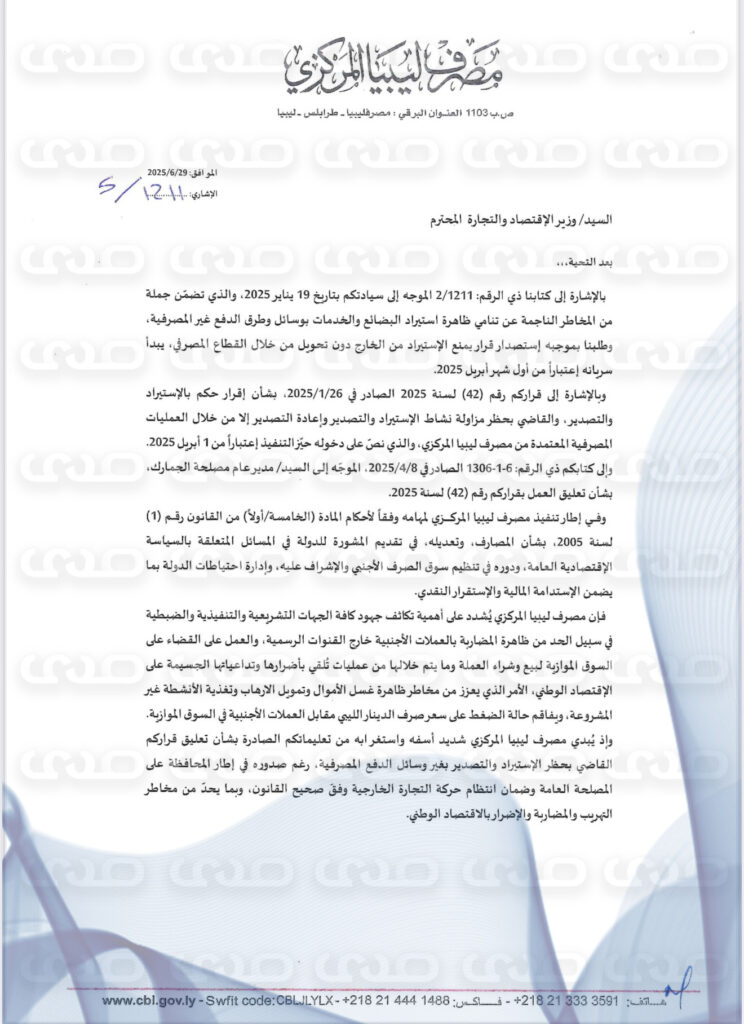
The Governor of the Central Bank of Libya, in a letter addressed to the Minister of Economy of the Government of National Unity, called for the resumption of the suspended decision regarding the regulation of import and export activities. This decision stipulates that the practice of import, export, and re-export should be restricted solely to banking operations approved by the Central Bank of Libya.
The letter, exclusively obtained by our source, included a request to issue instructions to the Customs Authority to prohibit import, export, and re-export activities unless conducted through legally approved payment methods, and to take the necessary measures to enforce the regulations governing imports and exports in a manner that serves the public interest and preserves the stability of the national economy.
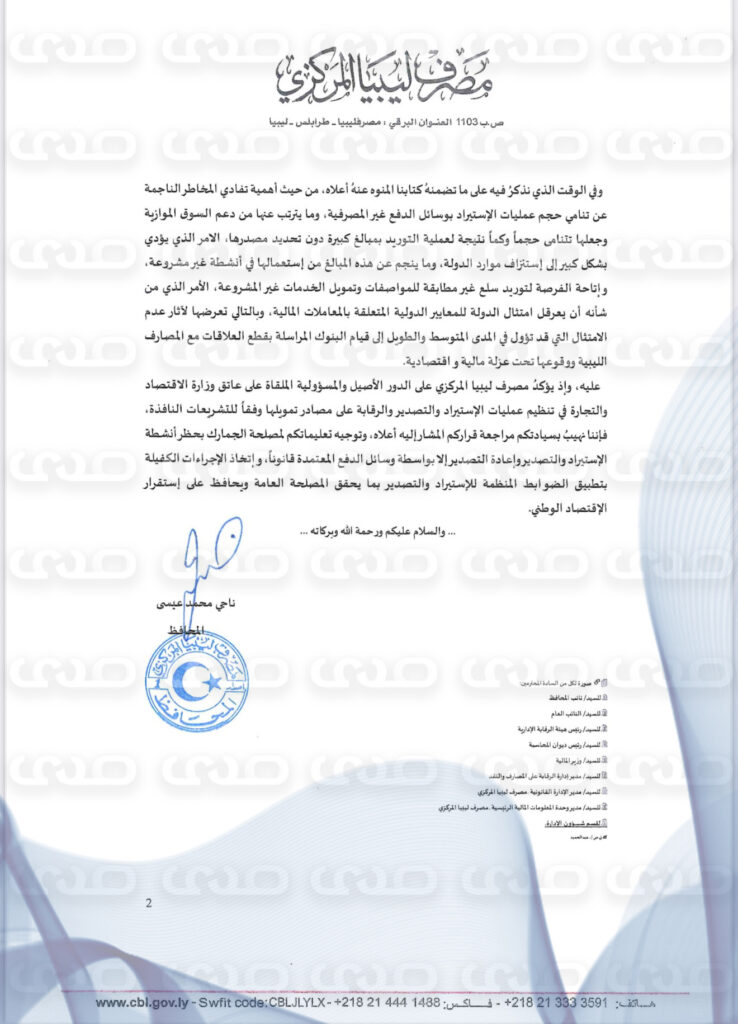
The Central Bank Governor told Mohamed Al-Huweij: “The Central Bank of Libya expresses its deep regret and astonishment at your instructions to suspend your own decision that bans import and export through non-banking payment methods, despite the fact that the decision was issued in the interest of the public good and to ensure the regularity of foreign trade in accordance with the law, while mitigating the risks of smuggling, speculation, and damage to the national economy.”
The Governor added: “While we reiterate the contents of our aforementioned letter regarding the importance of avoiding risks arising from the growing volume of imports through non-banking payment methods—and the consequent support of the parallel market, which continues to grow in size and volume due to the inflow of large sums of money from unknown sources—”
The Governor continued: “This situation greatly depletes the state’s resources and allows such funds to be used for illicit activities, including the import of substandard goods and the financing of illegal services. This, in turn, could hinder the state’s compliance with international standards related to financial transactions, which may eventually lead to correspondent banks severing ties with Libyan banks, exposing them to financial and economic isolation in the medium and long term.”
The Central Bank of Libya told our source exclusively that it has agreed on a mechanism to inject $1 billion for letters of credit and personal use, and to settle all pending requests in the system, with work accelerating starting tomorrow, Tuesday.
The Central Bank will continue monitoring all foreign currency requests from traders, including small-scale traders, in order to maintain the exchange rate at an acceptable level and eliminate speculative trading—aiming to curb rising prices and their impact on citizens’ living conditions and the overall cost of goods.
Our source has exclusively obtained a letter from the Governor of the Central Bank of Libya addressed to the Minister of Interior in the Government of National Unity.
In the letter, the Governor called for strict and deterrent measures to limit and eliminate the practice of buying and selling foreign currency outside official channels and in locations not licensed by the Central Bank of Libya. He urged the enforcement of legal penalties against individuals and entities involved in this illegal activity.
The Governor noted that the Central Bank has granted licenses to a number of exchange companies and offices, authorizing them to conduct foreign currency transactions. These entities are tasked with buying and selling foreign exchange according to the law and through official channels—namely, through the licensed companies and exchange offices established under the legal framework.
He emphasized that speculation in foreign currencies has become an openly organized activity in the parallel market and now represents one of the biggest economic challenges facing both the Central Bank and the Libyan state. This illegal trade fuels demand for foreign currency in the parallel market, which in turn finances illicit activities and contributes to the expansion of money laundering and terrorism financing.
Our source has exclusively obtained information about a meeting held at the Central Bank of Libya between the Governor and the heads of relevant departments.
The meeting focused on the plan to inject no less than $1 billion through the letters of credit system and the personal use foreign exchange system during this week.
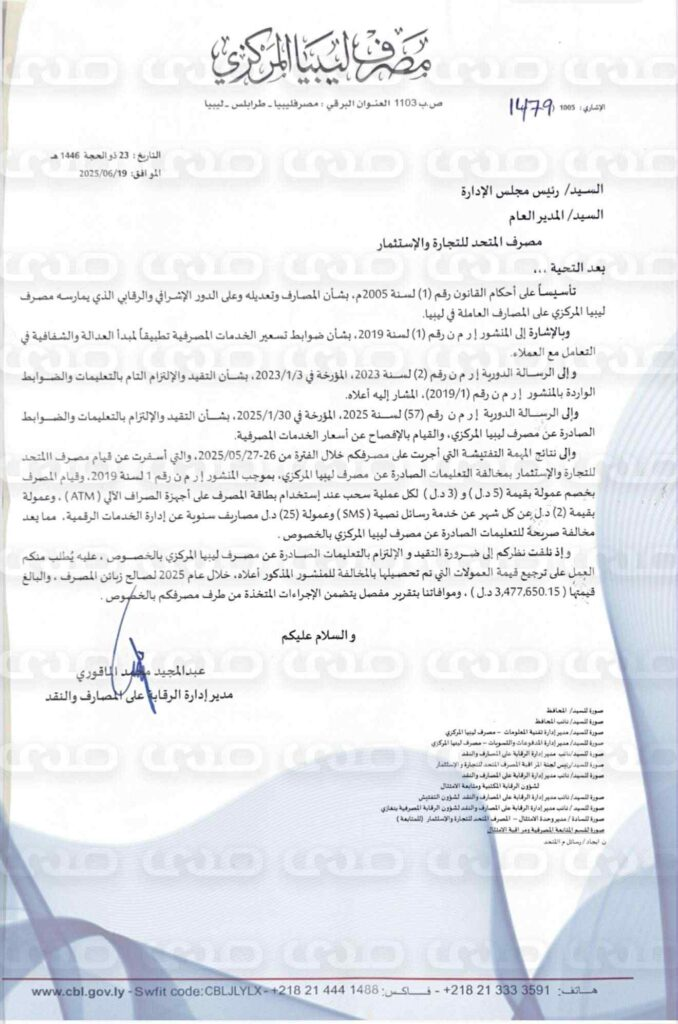
Our source has exclusively obtained a letter from the Central Bank of Libya addressed to UBCI, warning the bank over unauthorized deductions of fees from customers.
According to the findings of the inspection mission carried out at Al-Muttahid Bank between May 26–27, 2025, the bank was found to be in violation of the Central Bank’s regulations, by charging the following fees:
5 LYD and 3 LYD per withdrawal when using the bank’s card at ATM machines,
2 LYD per month for SMS notification services,
25 LYD annually as a digital service management fee.
These deductions were made in direct violation of the instructions issued by the Central Bank of Libya.
The Central Bank emphasized the need for strict compliance with its regulations and called on Al-Muttahid Bank to refund the total amount of 3,477,650.15 LYD to affected customers during the year 2025.
Additionally, the bank is required to submit a detailed report outlining the corrective measures taken in response to this directive.
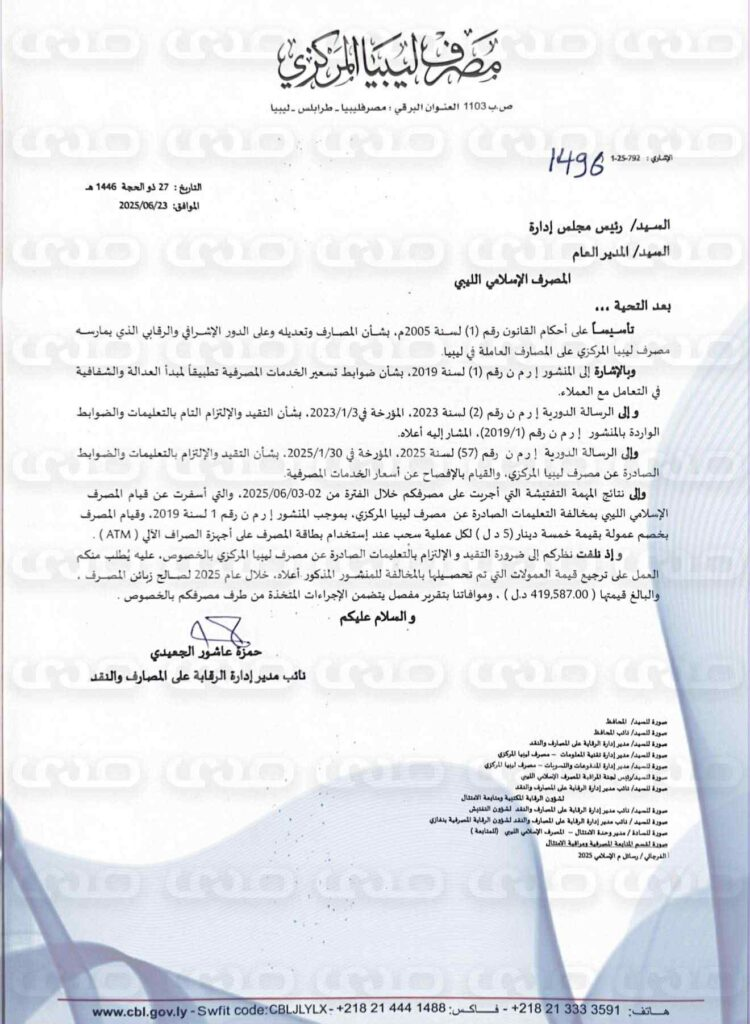
Our source exclusively has obtained a letter from the Central Bank of Libya addressed to the Libyan Islamic Bank, instructing the bank to refund fees it had deducted from customers, amounting to over 419,000 Libyan dinars.
The directive follows the findings of an inspection conducted on the bank, which revealed violations of the Central Bank’s regulations—specifically, Circular No. 1 of 2019. The bank was found to have imposed a 5 LYD fee for each cash withdrawal made using the bank’s card at ATM machines, which goes against the stated regulations.
The Central Bank stressed the importance of adhering strictly to its issued instructions and called on the Libyan Islamic Bank to reimburse the deducted amounts—a total of 419,587.00 LYD—to its customers during the year 2025, as these fees were collected in violation of the aforementioned circular.
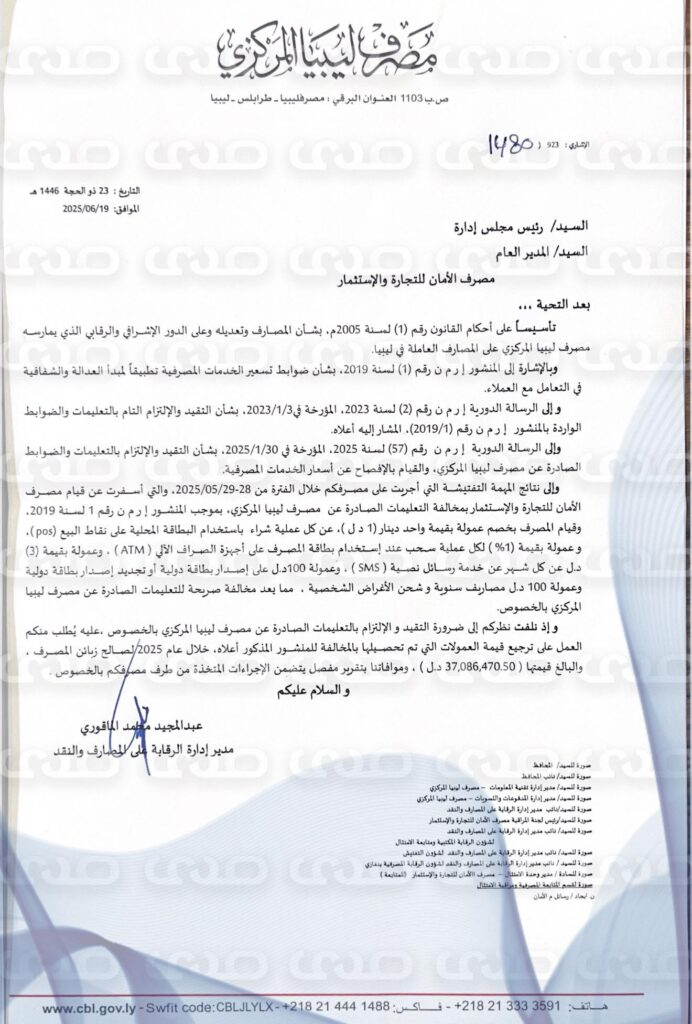
Our source has exclusively obtained — confirming what it reported yesterday — a correspondence from the Central Bank of Libya addressing Aman Bank for violating CBL instructions by deducting a commission of 1 dinar (LYD) for each purchase transaction using the local card at Point of Sale (POS) terminals, 1% commission for each cash withdrawal using the bank’s card at ATM machines, 3 LYD per month for the SMS notification service, 100 LYD for issuing or renewing an international card, and 100 LYD in annual fees and for personal goods recharge, all of which are clear violations of the instructions issued by the Central Bank of Libya in this regard.
The Central Bank also warned Aman Bank to adhere strictly to the issued instructions, and demanded that it repay the collected commissions that were in violation of the mentioned circular during the year 2025 to the bank’s customers, with the total value exceeding 37 million dinars.
Libyan businessman Husni Bey stated in an exclusive comment to our source: “The withdrawal of a banknote denomination or a specific issue of currency — whether it is the 50, 20, 5, or 1 dinar note — does not mean canceling the nominal value of the currency or the issue to be withdrawn. Rather, the withdrawal is merely a replacement of one form of money with another within the money supply, and a restructuring of the monetary base without any change to the overall totals.”
He continued: “For clarification, the term “money” applies to paper currency, which represents a liability of the Central Bank of Libya to the public (currency holders), in addition to deposit liabilities — or demand deposits — at commercial banks, which represent a liability of commercial banks to depositors.”
He added: “The proof that this decision does not reduce the total money supply or the monetary base (i.e., the Central Bank’s liabilities to paper currency holders + the reserves held at the Central Bank as legal reserve requirements, which stood at 20% of deposit liabilities until the end of 2024 and were raised to 30% by the Central Bank’s Board of Directors in 2025). Also, the cancellation of denominations does not affect additional reserves or the portion exceeding the 30% required by the Board.”
He confirmed: “For reference, the 30% threshold — the legal reserve or holding requirement — has been exceeded, bringing the total reserve held to nearly 50% (exceeding the required amount by 20%). This supports the theory that the liquidity shortage may be linked to this excess reserve, which was recorded during 2023 and the first quarter of 2024, during which the money supply increased by 37 billion dinars over 15 months.”
He concluded: “Canceling denominations does not amount to canceling money; it simply results in a replacement.” Based on published information about an additional 3 billion dinars in unreported currency, the negative effects of that may already have taken place. Yet, uncovering this breach allows the Central Bank to restructure the monetary base on scientific grounds. We now await the outcomes of the cancellation of previous issues of the 20-dinar note in order to complete the picture and make corrective decisions regarding past failures.”
The Central Bank of Libya revealed to our source exclusively: “Following complaints submitted to the Central Bank by small traders, the Central Bank of Libya has obligated commercial banks to open letters of credit on behalf of small traders, instead of limiting the service to a specific group.”
The Central Bank directed the management of commercial banks to meet the needs of small traders with a ceiling of $300,000 or less, and to increase the number of letters of credit issued for accessing foreign currency — in a way that ensures and promotes fairness in allocation. This move comes as part of efforts to support small traders and micro-entrepreneurs.
Our source at the Central Bank of Libya revealed in an exclusive statement that UBCI, Aman Bank, and the Libyan Islamic Bank are facing penalties today, following in the footsteps of Jumhouria Bank.
The source stated: The Central Bank of Libya is punishing the three banks and compelling them to return amounts deducted from customers’ accounts due to various violations, imposing strict sanctions. The banks are: UBCI, Aman Bank, and Libyan Islamic Bank.
He added:
Aman Bank — more than 30 million dinars
UBCI — around 5 million dinars
Libyan Islamic Bank — around 1 million dinars
He explained that these penalties were based on complaints from citizens and followed inspection tours conducted by the Department of Bank and Currency Supervision.
Our source at the Central Bank of Libya revealed to that the Central Bank has uncovered an illegal printing of the 50-dinar denomination, confirming that the bank officially received over 3 billion dinars more than the original printed amount (13.5 billion dinars), bringing the total recorded amount of 50-dinar notes to more than 16 billion dinars.
The source also pointed to concerns of possible counterfeiting in the 20-dinar note, labeling it as a suspicious denomination. This has prompted the Central Bank to accelerate its withdrawal as a measure to protect reserves, and it has now been officially included among the withdrawn denominations announced today.
Reassuringly, the source stated that the Central Bank has already printed a new, secure polymer-based currency that is resistant to forgery and illegal replication as a replacement for the withdrawn notes. Additionally, efforts are underway to expand electronic payment services.
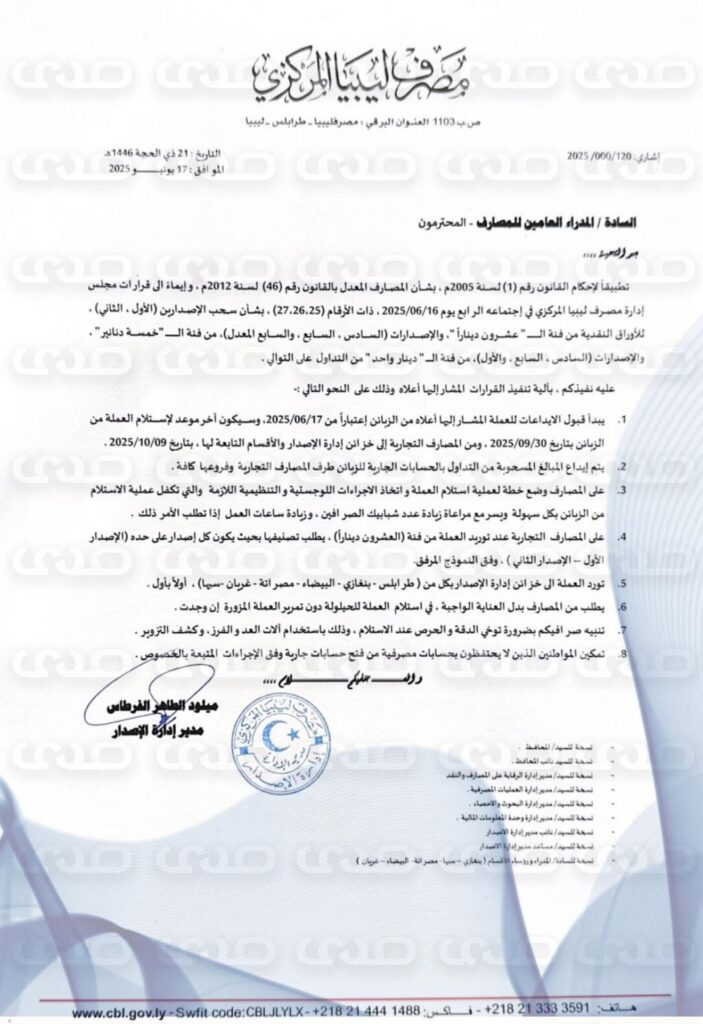
Our source has exclusively obtained a circular from the Director of the Issuance Department at the Central Bank, addressed to commercial banks, outlining the mechanism for implementing the decision to withdraw certain currency denominations from circulation (1 dinar, 5 dinars, and 20 dinars).
Key points of the circular:
Deposits of the mentioned banknotes by customers will be accepted starting from June 17, 2025, with the final deadline for accepting deposits from customers set for September 30. The final deadline for banks to transfer these banknotes to the vaults of the Issuance Department and its branches is October 9, 2025.
The amounts withdrawn from circulation are to be deposited into the customers’ current accounts at all commercial banks and their branches.
Banks are required to develop a plan for receiving the withdrawn currency and to take the necessary logistical and organizational measures to ensure a smooth and easy deposit process for customers, including increasing the number of teller windows and extending working hours if necessary.
When commercial banks deliver the 20-dinar notes, they must sort and categorize them by issuance (first issue – second issue), according to the attached template.
Withdrawn currency must be delivered to the vaults of the Issuance Department in Tripoli, Benghazi, Al-Bayda, Misrata, Garabulli, and Sebha on a rolling basis.
Banks are required to exercise due diligence when receiving currency to prevent the acceptance of counterfeit notes, if any exist.
Tellers must be alerted to exercise extreme caution and precision when receiving deposits, using currency counting and sorting machines, as well as counterfeit detection devices.
Citizens who do not currently hold bank accounts must be allowed to open current accounts in accordance with the applicable procedures.