Tag: salaries

Salaries: Between the Scourge of Corruption and the Demands of Need

Dr. Abdul Salam Nasia, an economist, wrote an article titled: Salaries: Between the Scourge of Corruption and the Demands of Need.

A salary is the material representation of the effort exerted by a worker or employee, typically determined according to the principle of “payment for work.”

Most countries establish minimum wage thresholds, whether for a specific task or hourly work, especially in the private sector. This approach grants employers the freedom to determine the nature and required hours of work, shaping what is known as the labor market. In all cases, countries aim to make compensation for work a tool for ensuring a decent living for individuals, preserving social hierarchy, national security, and promoting social justice.

In many countries, except for Arab oil-exporting nations, the government’s role in the labor market is minimal, confined to a limited number of public sector workers. The private sector is expected to absorb most of the workforce. State interventions are typically limited to offering allowances to job seekers until they secure suitable employment opportunities.

Conversely, in most oil-rich Arab countries, the state dominates the labor market, with the private sector playing a limited or negligible role.

Libya is one such country where the state reigns supreme in the labor market. There have been periods where the private sector was entirely absent, making the state the sole employer. This condition has led to an enormous inflation of the salary bill in terms of both size and value, negatively impacting resources allocated for development programs and projects, and causing delays in salary disbursements.

The issue of delayed salary payments in Libya is a chronic problem that has persisted for many years and is not merely a product of current circumstances. This issue has manifested in various forms over time, and its causes can be categorized into two primary groups.

The first group includes chronic causes, such as the marginalization of the private sector, leading to an increase in workforce concentration in the public sector. This overburdened the state budget. Additionally, the country’s reliance on a single income source—oil—makes it vulnerable to fluctuations in prices and quantities, directly affecting the state’s income and, consequently, the value and timing of salary payments.

The second group of causes emerged in recent years, highlighting the private sector’s weak ability to meet market demands and attract workers due to a lack of confidence in it and the higher salaries offered in the public sector. Furthermore, arbitrary salary increases and extensive public-sector hiring, driven by competition between governments and individuals to secure loyalty, have exacerbated the issue. This situation is compounded by currency depreciation due to institutional spending and increased government expenditure during periods of institutional division.

The state has recently witnessed a significant increase in the number of employees, raising the salary bill to more than 65% of the country’s total income. Unusual financial policies have also surfaced, such as “salary adjustments,” which are marred by widespread corruption. Additionally, dual employment and irregular revenue collection practices, including the National Oil Corporation withholding and mismanaging revenue, have further aggravated the situation.

Addressing this crisis has become a pressing priority for financial reform, particularly given the grim outlook for declining oil prices. Any delay in tackling this issue could deepen the economic and social crises the country is facing.

Exclusive: Central Bank of Libya Approves Covering the Deficit and Paying November Salaries to Avoid Delay

The Central Bank of Libya has confirmed, in a statement to our source, that the Bank’s Operations Management has started processing salaries after receiving them today from the Budget Department of the Ministry of Finance.

This comes after the approval of the Governor of the Central Bank to cover the deficit using the Bank’s resources, in order to avoid any delays in salary disbursement to citizens.

Exclusive: Directing Correspondence to Dbeibeh and His Government Entities, Shakshak Reveals Misuse of Unclaimed Basic Salaries

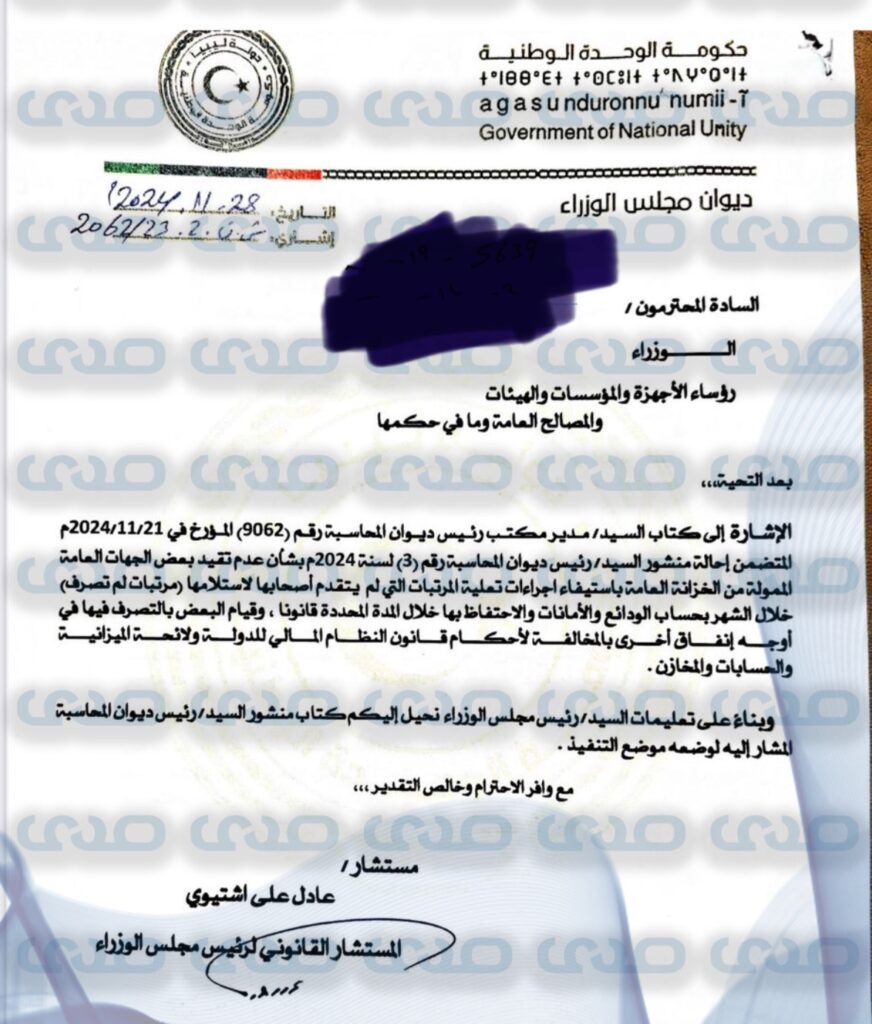
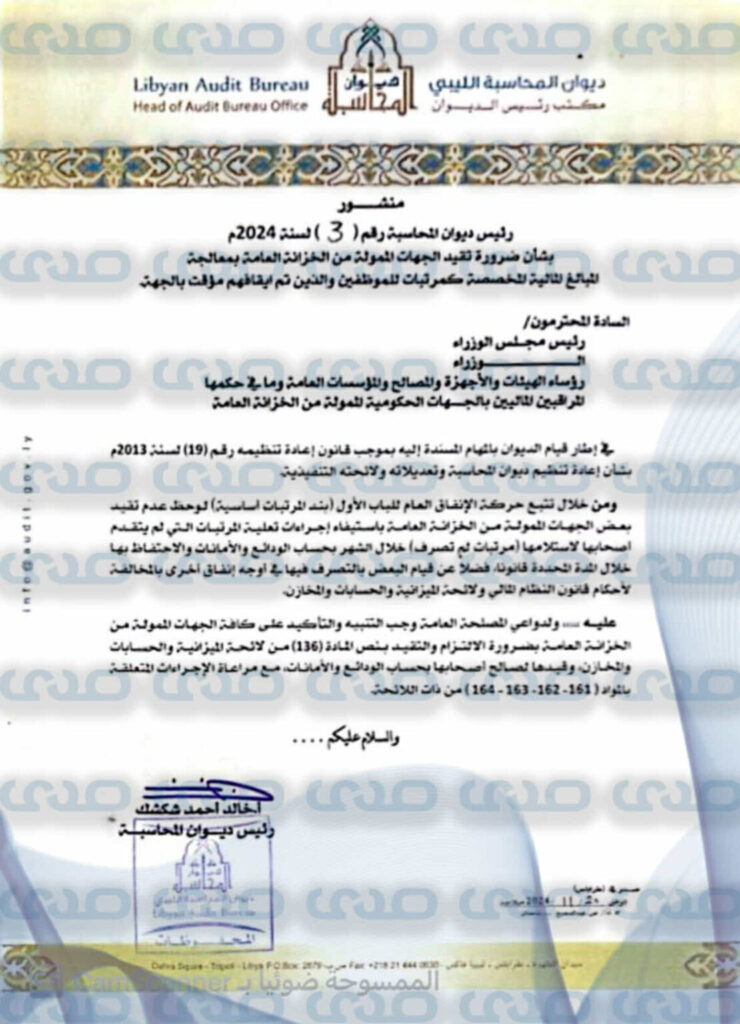
Our source has exclusively obtained a letter from the head of the Audit Bureau, Khaled Shakshak, addressed to the Prime Minister of the Government of National Unity, Abdul Hamid Dbeibeh, and affiliated government entities.

Shakshak revealed instances where unclaimed basic salaries were redirected to other expenditures in violation of the Financial System Law and the Budget, Accounts, and Stores Regulations. This was discovered through the Bureau’s tracking of spending movements under the basic salaries category.

In his correspondence to Dbeibeh and the relevant entities, Shakshak emphasized that some entities funded by the public treasury failed to comply with the procedure of transferring unclaimed salaries—those not collected by their rightful recipients during the month—to the deposits and trust account within the legally specified timeframe.

Shakshak stressed that, in the interest of public welfare, all entities funded by the public treasury must adhere to Article 136 of the Budget, Accounts, and Stores Regulations, ensuring that unclaimed salaries are recorded in the deposits and trust account in favor of their rightful owners.

From Cash Liquidity to Structured Salaries: A Data-Driven Analysis by Abu Sriwil

Dr. Yassin Abu Sriwil, an international trade expert, delves into Libya’s escalating economic challenges, revealing the impact of unstable financial policies on citizens and their families. In his article, he likens public salaries—an essential right—to credit facilities, questioning the current mechanisms and their repercussions.

The Core Issue: Numbers Speak

  1. Delayed Salaries
    • Public sector employees, 70% of Libya’s workforce, face salary delays averaging 60-90 days, leaving them financially vulnerable.
  2. Increased Demand for Cash
    • Cash demand surged by 25% in 2024 compared to 2023.
    • Black market cash transactions exceed 40 billion Libyan dinars annually.
  3. Imposed Credit Facilities
    • Credit system deductions reach 60% of actual salaries.
    • Digital payment withdrawals incur additional fees of 1-5%.

Role of Key Institutions

  1. Central Bank of Libya
    • Promised full liquidity by November 2024 but revised projections to 2025.
    • Despite lifting withdrawal limits, citizens bear extra costs under credit facilities.
  2. Government
    • Public spending hit 112 billion dinars in 2023, with 40% allocated to salaries.
    • Projections for 2024 indicate a 30-40% rise due to political divisions and duplicate spending.

Consequences of Current Policies

  1. Increased Black Market Reliance
    • Citizens lose 10-15% of their salaries obtaining cash.
    • Black market salary transactions exceed 5 billion dinars annually.
  2. Shadow Economy Growth
    • The informal sector expanded by 35% in five years, now contributing over 40% of GDP.
  3. Financial Drain on Families
    • Families spend 15-20% of their monthly income to bridge gaps caused by delayed salaries and high banking costs.

Proposed Solutions

  1. Regular Cash Flow
    • Ensure monthly cash injections of at least 10 billion dinars into banks.
    • Standardize salary disbursement by the 5th of every month.
  2. Reducing Black Market Dependency
    • Monitor money exchange offices with high-interest rates.
    • Launch government platforms for timely electronic salary transfers.
  3. Transparency and Anti-Corruption Measures
    • Address banking corruption draining 15% of GDP.
    • Reform subsidies to target productive sectors effectively.
  4. Formal Economy Boost
    • Increase investments in infrastructure and essential services by 10% annually.
    • Implement flexible policies to reduce the informal economy by 5% annually.

Conclusion
Amid central bank delays and government shortcomings, Libyan citizens remain the most affected. Sustainable solutions grounded in accurate data and political will are essential. Transforming salaries from a burden to a stabilizing economic tool can restore family stability and reduce reliance on the informal economy.

Exclusive: The Central Bank Issues Regulations to Facilitate Salary Disbursement Before Reaching Banks – Details Below

Our source has obtained a circular issued by the Central Bank of Libya to commercial banks regarding regulations for setting purchase limits based on individual salaries. The goal is to facilitate salary disbursement before funds are deposited into banks and to promote electronic payments.

The regulations stipulate that banks must establish purchase limits through electronic payment services they offer, such as electronic cards or mobile applications.

The limit granted to customers is considered a form of Qard Hasan (interest-free loan) and is subject to all its rules, terms, and Sharia-compliant regulations. Key conditions include:

  • No commissions, whether fixed or percentage-based, are to be charged on the overdraft amount.
  • Customers must not be required to subscribe to additional services to receive the limit.

The service is to be offered upon customer request through bank-specific mobile applications, SMS services, or signed forms that outline all product terms and conditions, approved by the bank’s Sharia supervisory board.

Each bank is required to establish policies and regulations for the service, including identifying target beneficiaries, service terms, and the procedures needed to safeguard the rights of both the bank and its customers. Banks may impose conditions for eligibility, restrict usage cases, set specific loan ceilings, or link the limit to the salary value, provided these conditions do not conflict with the bank’s financial policies or legal regulations.

The service is available to bank customers with active current accounts who have been receiving regular salary deposits for at least six months.

The granted limit must not exceed 60% of the net salary after deducting any installments or obligations. The used amount is automatically deducted from the limit when the salary is deposited, and the limit is renewed automatically unless either party decides otherwise.

The bank’s board of directors and Sharia supervisory board must approve the policies, product guidelines, terms, and models, ensuring compliance with regulations issued by the Central Bank of Libya.

Banks are also authorized to take all necessary technical and legal measures to recover their dues in cases where customers fail to prove insolvency. Additionally, banks may refuse to provide a Qard Hasan to clients with a history of defaults or other issues, as determined by approved policies and regulations to mitigate risks.

In light of this, the Central Bank has urged commercial banks to launch the product and prepare their systems to enable the use of these limits for electronic payment transactions in compliance with the aforementioned terms and regulations.

Exclusive: Al-Harati Comments on Government’s Return to Salary Increase Chaos

Legal advisor Hisham Al-Harati exclusively told our source: “Any increase in the salaries of state employees must be carried out in accordance with economic and legal controls that ensure financial balance for the state.”

He added: “Raising salaries without a corresponding increase in public revenues poses a direct threat to financial stability and could lead to a general budget deficit, putting the state at risk of bankruptcy.”

According to relevant general legal principles, any adjustment to the salary structure must take into account:

  • Balancing revenues and expenditures: ensuring sustainable financial resources to cover any proposed increases.
  • Preserving national economic stability: avoiding negative impacts on the value of the local currency or heightened inflation rates.
  • Conducting prior financial feasibility studies: demonstrating the impact of the increase on the general budget in both the short and long term.

He concluded: “Therefore, we urge legislative and executive authorities to make responsible and well-studied decisions that strike a balance between improving citizens’ living conditions and maintaining the state’s financial stability.”

Exclusive: Al-Jabo Comments on Salaries, Urges the Central Bank to Transfer Wages to Beneficiaries’ Accounts

Economic advisor Wahid Al-Jabo, in an exclusive statement to Sada Economic, said: “If the Ministry of Finance has prepared and directed the salaries on time with lists of state employees’ names, the Central Bank of Libya must transfer the salaries to the beneficiaries’ current bank accounts.”

He added, “However, if the allocations for Chapter One [salaries] have been exhausted, the Ministry of Finance should seek permission from the Central Bank to cover the salaries.”

Al-Jabo also noted that the halting of oil production and export in recent months might have had a negative impact on the Central Bank’s financial inflows, leading to salary delays. He emphasized the importance of clarifying the reasons for the salary delays between the Ministry of Finance and the Central Bank of Libya.

Exclusive: Central Bank to Sada: No Revenues Received for Months, October Salaries Funded by a Loan from Us

The Central Bank of Libya exclusively informed Sada Economic about recent developments regarding salary disbursements.

It revealed that no revenues have been transferred to the bank for months as of today, November 25, to cover salaries. As evidence, the Central Bank financed October’s salaries through a loan from its own resources.