Tag: audit bureau

Sada Surveys the Audit Bureau and Experts: A Runaway Dollar, Revenues Without Impact, and Development on Paper… 2026 Begins with an Early Economic Warning

With only one day left before the curtain falls on 2026, questions are mounting about the fate of the year and the economic and financial conditions it has produced amid a series of accumulated challenges. This year came as an extension of a phase marked by clear contradictions—most notably Parliament’s approval, on the last day of 2025, of a three-year development budget worth 69 billion, coinciding with a decline in revenues transferred to the Central Bank, continued pressure on the exchange rate, and what the Audit Bureau’s report revealed of violations and financial crimes.

Between development ambitions, the reality of economic indicators, and the future of exchange companies and the exchange rate, 2026 finds itself surrounded by legitimate questions about implementation levels, the ability to achieve financial stability, and the impact of adopted policies on citizens’ lives and the macroeconomy. This opens the door to a calm analytical reading grounded in facts and expert assessments, away from exaggeration or justification.

The Head of the Audit Bureau, Khaled Shakshak, told Sada Economic that the country’s economic situation is poor and concerning, and that the deficit persists at both local and foreign currency revenue levels amid rising risks. He stressed that the solution lies in unifying the authorities responsible for managing public funds, unifying the budget, ensuring accountability, and addressing the political impasse. He recommended consensus and institutional unification so there is a single authority, a unified budget, real oversight, and transparency—outcomes that can only be achieved through unifying authorities.

For his part, Abdulbasit Al-Jaboua, Director of the General Administration for Oversight of the Energy Sector and Public Companies, told Sada exclusively that the main reason behind the country’s economic situation is deteriorating conditions and instability in the Libyan dinar’s exchange rate. This is due to the scale of spending during 2024 and 2025, in both eastern and western regions. Spending exceeded collected revenues, placing significant pressure on the Central Bank regarding foreign currency, affecting the balance of payments and resulting in a deficit detailed in the Audit Bureau’s report.

Meanwhile, Abu Bakr Abu Al-Qasim, Head of the Accounting Department at the Libyan Academy, said the Libyan economy entered 2025 under increasing pressure—most notably a widening budget deficit and a persistent balance-of-payments imbalance—amid high and uncontrolled public spending, weak revenue collection including from the oil sector, and rampant corruption alongside weak performance by oversight institutions. These conditions directly affected citizens’ lives, contributing to higher inflation and erosion of purchasing power.

He added that the Libyan dinar faces ongoing pressure against foreign currencies due to rising demand for foreign exchange to finance imports and declining confidence in economic policies, pushing up dollar prices and the cost of basic goods and services. With limited policy tools, the citizen has become the weakest link in the financial and monetary imbalance.

These challenges are compounded by continued institutional fragmentation and multiple decision centers, weakening coordination between fiscal and monetary policies and delaying real reforms to address the twin deficits—costs borne by citizens through inflation. As 2026 approaches, serious questions arise about the economy’s ability to curb inflation, protect the national currency’s value, and restore a minimum level of economic and living stability. In the short term, this requires urgent measures, foremost among them: curbing runaway spending and agreeing on a single national budget within available revenue ceilings; improving governance of public revenues, especially the oil sector; activating oversight bodies to combat entrenched corruption; harmonizing economic policies across trade, fiscal, and monetary fronts; and reforming fuel subsidies that consume more than 30% of the budget.

Abu Al-Qasim concluded that continued financial and economic mismanagement—as in 2025 and prior years—will inevitably worsen conditions in 2026, with citizens once again paying the price.

Economic expert Suleiman Al-Shahoumi said 2025 was a year when the truth about Libya’s economic and monetary situation became fully apparent, marked by unprecedented runaway spending and legislative indifference to regulating public expenditure through a unified legal framework. He cited the so-called public debt law setting debt above 300 billion without scrutiny, shrinking oil revenues, loss and opacity of oil data, and a central bank that proved not truly unified and bears responsibility for today’s severe liquidity crisis.

He added that oversight institutions have failed in their roles, with unprecedented waste of public funds and corruption in contracting. Demand for dollars surged, fueled by the liquidity crunch and market distortions, while the Central Bank’s isolated actions and erratic monetary policies—amid loss of effective tools like interest rates—failed to improve conditions. He called for comprehensive restructuring of spending, fiscal tools (including tax and customs reform), and capable monetary policies to manage liquidity.

Mohamed Al-Senussi said 2025 was economically disastrous, with oil revenues not fully transferred to the Central Bank despite claims that barter had stopped—when it continues in other forms. Dual spending without a budget persists, explaining deficits in Central Bank data. He stressed that fiscal policy drives the real economy in Libya and that monetary policy should support it, not firefight its failures. He warned 2026 would be worse without unified budgeting, full revenue transfers, adequate liquidity provision, and exchange-rate adjustment to meet demand. He proposed quick fixes—exchange-rate adjustment, adequate liquidity, lower e-payment fees—and political solutions, including a single government, unified budget, and anti-corruption measures.

Businessman Hosni B. said Libya’s economy, despite vast oil resources, remains on the brink of unsustainability due to soaring spending, falling oil prices, persistent liquidity crisis, and a flawed economic model. He estimated public spending exceeding 230 billion dinars in 2025, a revenue-expenditure gap over 30 billion, and reliance on foreign-currency sales and reserves—weakening the state’s medium- and long-term position. He argued the liquidity crisis is one of trust, not money scarcity, and criticized the fixed exchange-rate policy for fueling speculation, parallel markets, hoarding, and liquidity stress. He called for flexible exchange rates, unified fiscal and monetary decisions, spending rationalization, private-sector empowerment, transparency, and redefining the state’s role.

Former Central Bank board member Murajeh Ghaith said 2025 was marked by inflation, higher prices, and chronic liquidity shortages. He urged rationalizing dollar use toward productive ends, approving a unified budget, controlling spending, and monitoring foreign-currency use. Without these, no improvement is possible in 2026.

Economist Mohamed Al-Barghouthi said 2025 was fragile rather than collapsed—temporary stability masking deep structural imbalances. Oil revenues exist but fail to translate into durable exchange-rate stability or purchasing-power gains due to weak management, lack of transparency, delayed revenue collection, and political interference. He warned that continued high spending and delayed reforms could renew pressure on the exchange rate and inflation in 2026, while genuine reforms—depoliticizing the economy, improving revenue governance, and restructuring toward production—could preserve and gradually improve stability.

Finally, economist Mohamed Al-Rafadi said Libya’s reported growth—around 13%—is fragile and misleading, driven by oil prices and stable production rather than real performance. Chronic fiscal deficits, political division, poor resource management, uncoordinated fiscal and monetary policies, and politicization of economic tools persist. True assessment lies in living standards, which continue to deteriorate. Without deep treatment, he warned of inevitable economic collapse, stressing that the crisis is fundamentally political and that recovery requires insulating the economy from political conflict and building competent, independent economic management.

Share the news

Key Highlights of the Libyan Audit Bureau Report for 2024

The Libyan Audit Bureau published its 2024 report, confirming that the Council of Ministers of the Government of National Unity dispatched 11 envoys through seven procedures to receive overnight allowances for foreign missions amounting to LYD 119.8 thousand, while accommodation was charged to the state through a private company at a cost of LYD 447.8 thousand, despite the envoys having received the full allowance and being provided with free public housing. This indicates the submission of misleading declarations and the realization of unlawful gains.

According to the report, direct oil barter spending reached a cost of 44.5 billion, causing distortions in state data and misrepresenting the true situation. The deficit has continued from 2014 to 2024, reaching LYD 38 billion, excluding the government in the eastern region, in addition to the existence of oil quantities that are not disclosed or reported.The report also noted a decline in revenues transferred to the treasury in 2024, falling by 47% compared to 2022, and the existence of a gap of about USD 9.2 billion between realized sales and collected value due to the total cost of crude oil swaps for fuels and expenses.

The Bureau further pointed to losses in the investments of the Libyan Foreign Bank despite support provided to the Niger Commercial Bank, and Burkina Faso’s nationalization of Burkina Commercial Bank, in which the bank holds a 50% stake, due to the Libyan side’s lack of seriousness in honoring commitments and shortcomings of the bank, as well as a decline in its contributions to North Africa Bank Tunisia.

Total investments in Sahel commercial countries amounted to USD 118.9 million, while returns since establishment did not exceed USD 13.6 million, with returns not exceeding 11% of total investment cost, reflecting shortcomings and underperformance, according to the Bureau.The report also indicated that oil companies submitted inflated and unrealistic budgets, with a decline in the National Oil Corporation’s share due to the entry of new partners and preferential payment terms granted to certain clients. Oil sector expenditures rose to 32.5 billion, alongside expanded spending on foreign missions.The Corporation also rented housing for some employees at amounts reaching LYD 30,000 per month, fragmented vehicle supply contracts to evade Bureau oversight, transferred LYD 15.9 million to a German car company for vehicle supply, and carried out direct appointments of individuals lacking professional qualifications and unrelated to oil specializations.

The report revealed that the value of assets of the Libyan Investment Authority reached approximately USD 72.8 billion, an increase of USD 1.1 billion compared to 2023. The Libyan Internal Investment Fund continued to incur losses, with net losses of about USD 3.4 million during the first half of 2024, amid weak performance of subsidiary companies and failure to adopt effective solutions to stop the ongoing drain of public funds.Some subsidiaries within the long-term investment portfolio continued to struggle and incur consecutive losses, including the Housing, Tourism, and Hotel Investment Company affiliated with Sabitna, without fundamental solutions to address their conditions.

The Central Bank of Libya invested the Authority’s deposits with the Libyan Foreign Bank in violation of approved provisions stipulating that funds be invested in time deposits with global banks, with the value of deposits invested in the Libyan Foreign Bank reaching about USD 2.5 billion.The report also stated that central bank reserves reached LYD 409 billion (equivalent to USD 83 billion), alongside an increase in its currency and gold assets.According to the report, the State Properties Authority – Abu Salim Office waived usufruct rights to a vacant land plot in Abu Salim measuring 10.6 thousand square meters in favor of North Africa Development and Investment Holding Company for 90 years for LYD 86.2 thousand, while the true value of the land is no less than LYD 2.6 million.

It also waived usufruct rights to land hosting the old Abu Salim market, measuring 34.2 thousand square meters, for LYD 204.7 thousand, while its real value is LYD 8.3 million.The Authority further waived land of 21 thousand square meters to the same company for LYD 302 thousand, despite a real value of LYD 4.9 million, and waived usufruct of land in Tripoli Central Municipality measuring 1.8 thousand square meters for LYD 304.5 thousand, though its true value is at least LYD 450 thousand. The report also cited the company’s seizure of properties, including a warehouse belonging to Waha Oil Company and a property of Al-Aman Bank, and the signing of a contract to develop the Abu Salim beverage factory between Al-Kawthar Water Company (affiliated with North Africa) and the Internal Investment Fund, with an estimated cost of LYD 200 million, which constitutes suspected corruption.Additional costs were imposed on Zallaf Oil Company due to its contract with North Africa Development and Investment Holding, in partnership with Ural Drilling, to execute onshore drilling services for water wells, despite North Africa’s lack of specialization in this field.

Regarding the investment sector, the report noted a 7% decline in revenues of the Libyan African Investment Company (LAICO) due to the absence of dividend distributions and a sharp decline in extraordinary revenues. The bulk of revenues, amounting to LYD 16.39 million, consisted of interest on non-performing and hard-to-collect loans, rendering these revenues uncertain in terms of cash realization.Expenses increased by 19% due to a 43% rise in administrative and general expenses (equivalent to LYD 2.5 million), reflecting unjustified spending expansion and financial instability. Profits do not reflect real performance due to reliance on interest from distressed loans, weak oversight of administrative expenses, and continued deterioration of LAICO Tunisia’s financial performance, which recorded increased losses in 2023 by TND 1.9 million compared to 2022, alongside rising financial obligations reaching USD 2.1 million, classified as high-risk liabilities, threatening the company’s continuity and operations.The financial performance of the Mediterranean Company for Tourism Studies and Projects also deteriorated, shifting from profits in 2022 to losses in 2023 amounting to TND 941.7 million.

The Ghanaian Arab Libyan Holding Limited recorded increased financial obligations reaching USD 32.5 million, including loans and interest, exposing it to significant financial risks.According to the report, LAICO Central Africa incurred escalating financial losses during 2022–2023 exceeding 5.9 billion CFA francs, reflecting ongoing financial deterioration. It also noted the failure to specify currency type in LAICO Zambia’s lease contracts and disproportionate rental prices, where the same villa’s rent reached USD 2,000 in earlier years and later fell to USD 200.The report observed that rental values were often low relative to the leased assets, including leasing a café for 2,500 Zambian kwacha per month (about USD 150) without clearly specifying the area, and leasing a complex including a gym, tennis court, squash court, swimming pool, two saunas, and other facilities for 27,000 Zambian kwacha per month (about USD 1,600). It also highlighted a significant increase in penalty clauses upon contract termination by the company, including USD 800,000 for terminating a contract with Falcon Company and 500,000 Zambian kwacha for terminating the café contract, as well as long-term contracts of up to 20 years without clear justification.Legal expenses rose to about 1.1 million Zambian kwacha in 2023 due to multiple cases, notably disputes over legal representation of the company. The report also noted the general manager’s salary rising to EUR 6,075 per month, in addition to a quarterly performance-based bonus that could reach EUR 33,000 annually.Revenues declined due to reduced demand for villa and office rentals because of aging assets and maintenance needs, with several units taken out of service, neglect of green spaces, and intensified competition in the sector.

Total equity as of December 31, 2023 stood at a negative 2.6 million Zambian kwacha. Payments of 18.1 thousand Zambian kwacha were made via a check dated July 15, 2016 for renovation works without authorized disbursement, and 18 thousand Zambian kwacha were paid for labor costs without supporting documents.The report also cited the inclusion of the former finance director’s salaries under maintenance expenses to reduce taxes, based on handwritten notes on disbursement vouchers, despite attached invoices from suppliers and contractors, undermining their credibility. It recorded the payment of EUR 33.3 thousand on January 22, 2024 to the general manager as an annual bonus for 2023, despite the company not achieving profits that year, in addition to cash withdrawals to cover various expenses at the request of the general manager instead of using approved banking instruments such as checks or transfers.

Exclusive… “Al-Majbari” to Sada: The Audit Bureau’s 2024 report will be published soon

Anis Al-Majbari, Director of the Planning and Reporting Office at the Audit Bureau, told our source that within 20 to 30 days, the Audit Bureau’s 2024 report will be ready for publication and referral to the legislative authority, as part of the oversight bodies, with the Audit Bureau being the highest oversight institution in Libya, established in accordance with the constitution.

Al-Majbari added: “Through cooperation with peer oversight bodies, a strategy has been developed to achieve the greatest benefit in strengthening anti-corruption efforts.”

Exclusive.. Shakshak Reveals to Sada the Release Date of the Audit Bureau’s 2024 Report and Details of the New Strategy

Head of the Audit Bureau, Khaled Shakshak, told our source exclusively:

“There is no fixed date yet for disclosing the Audit Bureau’s 2024 report, but I believe it will be soon. The report is complete; we are now in the stage of final reviews and drafting, and it will be issued shortly.”

He continued:
“The idea of the strategy is not for the Bureau to be the sole entity publishing data. Each institution should be responsible for publishing its own data. While the Bureau and some institutions currently publish certain information, the strategy envisions an organized legislative and legal framework that obliges all parties to publish data themselves—on a monthly or quarterly basis. For example: how much money they received, how much they spent, the types of expenditures, and if they have contracts, these should be published through the contracts platform, specifying what the contracts are and with whom. This is essentially about raising the level of transparency.”

Shakshak added:
“As for the Bureau’s reports, we usually issue a comprehensive annual report. As for periodic reports, we regularly prepare them, but they are specific to a sector or entity and addressed directly to it. These are not published to the public. Public disclosure is reserved for the comprehensive report that covers all aspects.”

He went on:
“The joint committee between the Anti-Corruption Authority and the Audit Bureau will have its own headquarters, work plans, and delegated powers from the heads of both institutions, with dedicated support from both sides and even from other stakeholders. It will start its work in a semi-independent manner under our supervision. The committee will function almost independently to implement a specific project within the strategy over a defined timeframe.”

Shakshak concluded:
“The private sector is not included in the strategy itself—what is included is its relationship with the public sector. When there is a contractual or financial relationship between them, then the Anti-Corruption Authority becomes responsible for monitoring the private sector, while the Audit Bureau focuses on the public sector. Cooperation between both sides will be fruitful in this regard, within a clear legal and legislative framework.”

Exclusive: Shakshak to Qaderbouh — Ignoring Legislation Exposes You to Accountability; We Avoided Embarrassing You for Not Understanding It

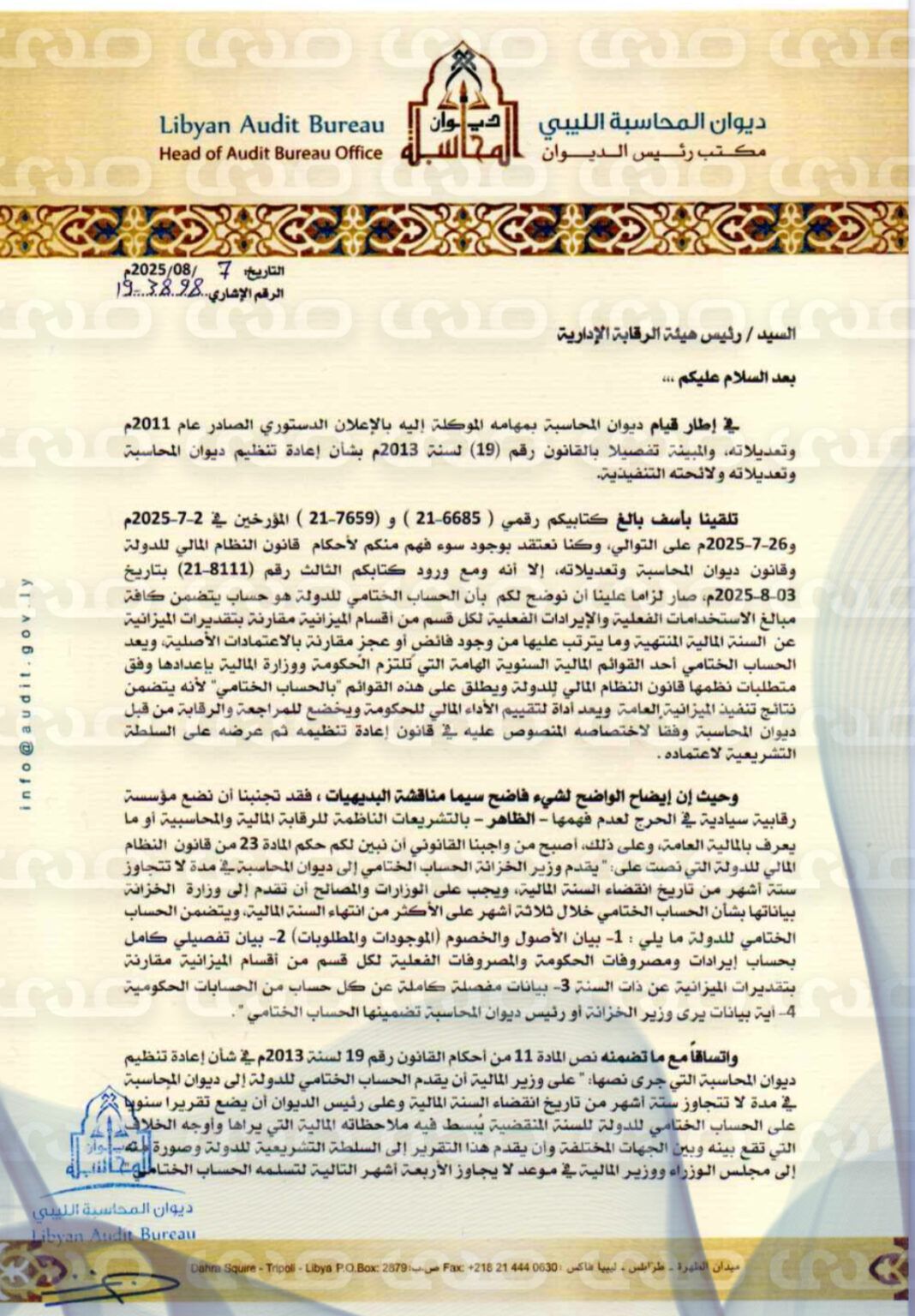
Our source exclusively obtained a letter from the President of the Audit Bureau, Khaled Shakshak, addressed to the Head of the Administrative Control Authority, Abdullah Qadurbouh, regarding the closing of the state’s final accounts.

Shakshak said: “Clarifying the obvious of a scandalous matter, especially discussing basics, we avoided putting a sovereign oversight institution in embarrassment due to its apparent misunderstanding of the financial and accounting oversight legislations, also known as public finance.”

He continued: “Preparing the final accounts is an original responsibility of the government through the Ministry of Finance. The Audit Bureau’s role lies in reviewing and commenting on them, while the Administrative Control Authority’s role is to follow up on Ministry of Finance employees and executive bodies through accountability and investigation to ensure their performance of duties, including preparing the final accounts. Undoubtedly, if this is achieved, it will positively impact achieving the goal, considering technical obstacles and problems away from the financial oversight outside the Authority’s jurisdiction.”

He added: “I have continuously urged the government to close the state’s final accounts through many correspondences, meetings, and annual reports issued by the Audit Bureau due to its great importance to assess the state’s financial situation. Moreover, the last final account received by the Audit Bureau was for the fiscal year 2009, which was reviewed and commented on.”

Shakshak concluded to Qaderbouh: “Your stubbornness and non-compliance with the effective legal legislations, your failure to abide by the rulings of the Constitutional Chamber of the Supreme Court, and other judgments in disputes, especially those raised by the Head of the Administrative Control Authority in his capacity — rulings that favored the Audit Bureau — expose you to legal and criminal accountability according to the Penal Code and the Law on the Reorganization of the Supreme Court.”

Exclusive – After Being Publicly Wronged by the Audit Bureau Over Companies He Holds Shares In… Husni Bey Demands a Public Clearance Statement on the Bureau’s Page

In an exclusive interview with our source, Libyan businessman Husni Bey made a direct appeal to the President of the Audit Bureau, Khaled Shakshak, calling for justice and correction of what he described as a “grave injustice” inflicted on his companies and their directors. This came as a result of what he called a malicious decision issued by the Bureau in October 2015, accusing two companies he holds shares in — and their managers — of false allegations, including customs evasion and money laundering, claiming money transfers were made without importing goods, which he asserts was not the case.

He added:

“The decision hit like a thunderbolt. It was widely and openly announced on the Bureau’s official page and republished by media outlets. We were falsely accused, and individuals working as managers or even family members who own shares in the companies were unjustly harmed.”

He explained that the decision was issued under No. 398 on October 11, 2015, and was revoked less than three weeks later through Decision No. 431 on November 2, 2015, after it was proven that the active company in question was not affiliated with him. However, the revocation was not announced in the same public manner as the accusation, resulting in the allegation continuing to follow them in official transactions to this day.

Bey continued:

“We requested that the exoneration be announced with the same level of exposure as the accusation, but it never happened — as if the immense harm they caused is irrelevant, even though its repercussions can’t be compensated for, neither financially nor morally.”

He clarified that the error was not only in the accusation but also in misidentifying the companies involved. There was a confusion between:

  • His company “Siran Pharmaceuticals”, part of his group
  • And another company “Siran Tires”, which was actually involved in the alleged currency and goods smuggling — as discovered after further investigation.

He added:

“In addition to the name confusion, the issue was also a small numerical error in the customs declaration — between 3230 and 3239 — a minor discrepancy with disastrous consequences.”

He emphasized that the public defamation was triggered by a customs fee difference of only 15,000 dinars, despite 70,000 out of 85,000 dinars in dues being paid. He questioned:

“Is it reasonable to accuse a company that pays tens of millions in customs duties of evading over just 15,000 dinars?”

The businessman concluded his appeal by saying:

“I urge Mr. Khaled Shakshak and the Audit Bureau to give us justice. Our name was wrongly included among 26 companies, and 9 of our managers were accused among 97 individuals mentioned in the same decision. There may be others who were also wronged.
Despite everything, we thank the Audit Bureau for its reports that have uncovered many violations — but we still await justice… because we were wronged.”

Exclusive: Tripoli Primary Court Rules in Favor of the Audit Bureau on Pre-Contract Oversight

Exclusive sources told our source that the South Tripoli Primary Court has issued its ruling regarding the appeal submitted by the President of the Administrative Control Authority, in his capacity, concerning the implementation of the Constitutional Chamber’s ruling in constitutional case No. 70/9Q. This case had previously ruled the unconstitutionality of Law No. 2 of 2023, issued by the House of Representatives, which amended the law governing the Administrative Control Authority.

According to the court ruling, it reaffirms for the second time that pre-contract oversight is the exclusive jurisdiction of the Audit Bureau, and no other entity. This puts a definitive end to any legal ambiguity regarding the distribution of oversight powers. Consequently, the Administrative Control Authority does not have the authority to carry out this type of oversight, thereby strengthening the principle of separation of oversight bodies and reinforcing respect for judicial rulings—particularly those of the Supreme Court.

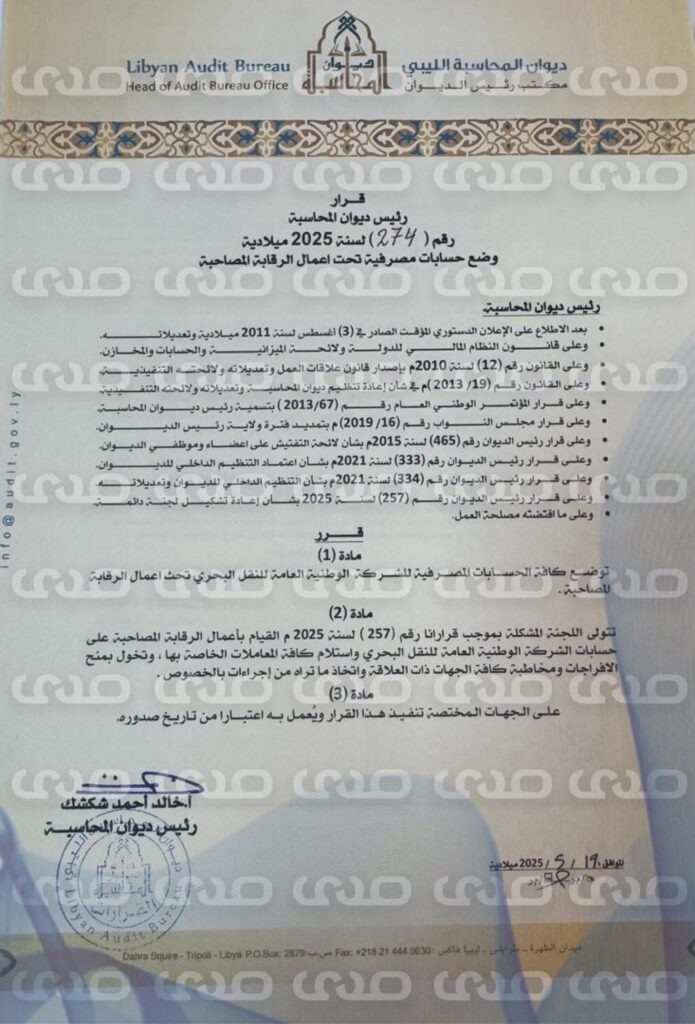
Exclusive: Shakshak Issues Decision to Place All Bank Accounts of the General National Maritime Transport Company Under Concurrent Oversight

Our source has exclusively obtained the decision issued by the President of the Libyan Audit Bureau, Khaled Shakshak, to place all bank accounts of the General National Maritime Transport Company under concurrent (accompanying) oversight.

The committee formed by his Decision No. (257) of 2025 is assigned to carry out the oversight of the company’s accounts, receive all related transactions, and is authorized to issue approvals, correspond with all relevant entities, and take any measures it deems appropriate in this regard.

image 2025 05 19 160806397

Exclusive: For These Reasons… Shakshak Urges Dbeibeh Not to Take Any Measures to Implement His Decision to Cancel 25 Embassies and Diplomatic Missions Abroad

Our source has exclusively obtained a letter from the President of the Audit Bureau, Khaled Shakshak, addressed to the Prime Minister of the Government of National Unity, Abdul Hamid Dbeibeh, urging him not to take any measures that would implement the decision to cancel 25 embassies and diplomatic missions abroad and merge them with other missions. This recommendation is based on the Bureau’s jurisdiction and in accordance with Law No. (19) of 2013 concerning its reorganization and the follow-up and execution of the observations included in the Bureau’s reports.

Shakshak explained that, based on the documents submitted to implement the said decision and to achieve the intended objectives efficiently and effectively, the Bureau recommends a comprehensive review before taking any measures or execution procedures. He emphasized that diplomatic missions abroad, as well as the Deputy Minister of Foreign Affairs for Consular, International Cooperation, or Political Affairs, should refrain from taking any steps to implement or amend the decision or issue any executive orders until the following issues are fulfilled:

  • Review the financial, staffing, legal, political, sovereign, organizational, administrative, and procedural status of the missions proposed for cancellation, merger, or retention.
  • Inventory and evaluation of assets and properties such as vehicles, buildings, equipment and furnishings, administrative and diplomatic archives, financial records, entrusted assets, electronic devices, phones, and international numbers, etc.
  • Inventory and evaluation of human resources, including local staff, attachés, and advisors, with a clear determination of their salaries, benefits, entitlements, insurances, debts, and employment rights.

Once the above issues are addressed, employees from closed missions must be reassigned to other missions and their employment status handled properly, including contract terminations. Lease agreements, partnerships, guarantees, and contractual obligations should be reviewed, as well as the legal standing of the closed missions to ensure there are no legal impediments to their closure.

It is also essential to preserve classified archives and documents by legal means and to provide an implementation mechanism that ensures the diplomatic staff’s rights during their transition to new workplaces. Ongoing legal disputes raised by diplomatic staff in this regard must also be addressed. A comprehensive file for each closed diplomatic mission should be prepared, detailing its financial, administrative, and legal status, as well as the condition of the building, debts, entrusted assets, dues, and international subscriptions.

Additionally, merged missions must be reviewed, including diplomatic agreements with host countries concerning the status of missions, and host countries should be notified of the closure of diplomatic missions in accordance with legal protocols and international norms.

Exclusive: For These Reasons, Shakshak Suspends Two Officials from Brega Oil Company from Work

Our source has exclusively obtained the decision issued by the Head of the Libyan Audit Bureau, Khaled Shakshak, regarding the suspension of Saad Al-Din Al-Zaidi, in his capacity as Director of the Financial Department for the Western and Southern Regions at Brega Petroleum Marketing Company, and Mohamed Mansour Al-Fallah, Director of the Services Department at the same company.

This suspension comes due to their obstruction of the committee assigned to audit and review the accounts of Brega Petroleum Marketing Company by the General Administration for Oversight of the Energy Sector and Public Companies at the Bureau, and for violating the Audit Bureau’s regulatory law.

Exclusive: House of Representatives Reaffirms Shakshak’s Continuation as Head of Audit Bureau and Revokes Appointment of Atiya Abdulkarim as Deputy

Our source has exclusively obtained a circular from the Libyan House of Representatives regarding the continued assignment of Khaled Shakshak to his duties as Head of the Audit Bureau, until the unification of sovereign institutions in a manner that ensures the proper functioning of the administration entrusted to him. The House also decided to fully revoke the decision to appoint Atiya Abdulkarim as Deputy of the Bureau.

According to the decision, the appointment of deputies for supervisory bodies and entities affiliated with the legislative authority and governed by law must be issued by the House of Representatives in an official session and in accordance with the provisions of effective legislation. Any other decisions issued in this regard shall not be recognized.

Deputy of the Audit Bureau Describes Shakshak’s Actions Against Malek Baayou, Convicted by Libyan and Tunisian Courts with Official Documents, as Arbitrary and Calls on the Attorney General to Intervene

The Deputy of the Audit Bureau has sent a letter to the Attorney General regarding a complaint filed by Malek Baayou, General Manager of Al-Inma Oil & Gas Company, in which he described actions taken against him by the head of the Audit Bureau as arbitrary. He emphasized that the company he manages is a Libyan joint-stock company with private funds that are not subject to the Bureau’s oversight. He urged the Attorney General to address the measures and correspondence issued by the Bureau in light of the referenced judicial rulings.

The Public Prosecution had previously placed Malek Baayou on the travel watchlist, issued an arrest warrant against him, and referred him to the Attorney General’s Office based on ongoing investigations into a report filed by the head of the Audit Bureau.

It is noteworthy that Malek Baayou appeared before the specialized criminal division for financial corruption cases at the Tunis Primary Court alongside his wife. They were prosecuted for charges of aggravated breach of trust, money laundering by exploiting professional privileges, and complicity in these crimes.

The case originated from a complaint filed by the legal representative of a branch of Al-Inma Oil & Gas in Tunisia, alleging that the defendant caused financial harm and embezzled significant sums amounting to billions of millimes.

The Audit Bureau had previously issued a report uncovering corruption within Al-Inma Oil & Gas, detailing the procedures of a $30 million loan granted to the company through Al-Inma Financial Investments Holding Company. On May 30, 2018, the General Manager of Al-Inma Oil & Gas sent an official request (Letter No. 165-2018) to the fund’s Board of Directors, asking for the completion of the company’s capital with an amount of 56.5 million Libyan dinars.

The report exposed extensive corruption and violations, including Malik Baayou transferring funds from Al-Inma’s Tunisian branch to his own “single-member company” under the name “International Trade Complex,” with a transferred amount exceeding $6 million.

The Audit Bureau’s report also revealed coordination with the Attorney General’s Office regarding this case, leading to the suspension and referral of the General Director for Corporate Performance Evaluation to the Attorney General, as well as the suspension of several officials from the Social and Economic Development Fund. Several committees were formed to conduct audits and verification processes, including one tasked with assessing financial transactions at Al-Inma’s Tunisian branch, which was prevented from performing its duties by the branch’s management. Another committee was established to follow up on financial corruption related to the loan grant, initiating interrogation records for those involved in preparation for their referral to the Attorney General’s Office.

Exclusive: Deputy Head of Audit Bureau Responds to Shakshak on Failure to Hold Corrupt Officials Accountable, Calls It a Negative Message and a Denial of Responsibility

In an exclusive correspondence obtained by our source, the Deputy Head of the Libyan Audit Bureau addressed Law No. 19 of 2013, affirming that it grants the Bureau sufficient powers and responsibilities to curb corruption.

He highlighted Article 17, which authorizes the Bureau to request that relevant entities take necessary measures to recover public funds that were misused or spent in violation of laws and regulations.

Article 18 mandates the Bureau’s head to alert the Prime Minister or the concerned minister about any avoidable financial losses or unnecessary burdens on the state’s resources, applying the same scrutiny to laws and regulations.

Article 19 empowers the Bureau’s head to compel any employee within the audited entities or any public service official to reimburse funds they unlawfully disbursed or authorized.

Under Article 20, if financial misconduct is detected, the Bureau’s head has the authority to suspend the entity’s accounts and place them under ongoing audit until the issues are resolved.

Article 47 allows the Bureau’s head to suspend employees in audited entities for up to three months, extendable by the relevant disciplinary council.

The Deputy Head reminded the Bureau’s President that for the past decade, the Bureau has held the authority of prior oversight over all state contracts, including procurement, construction, and financial commitments. He emphasized that every contract covered by this provision had received the Bureau’s approval, questioning its current stance on corruption accountability.

Exclusive: Addressing Shakshak, Deputy Head of the Audit Bureau: “The Bureau Must Never Become a Bargainer and Price Enforcer”

Our source has exclusively obtained a letter from the Deputy Head of the Libyan Audit Bureau, Atiyat-Allah Abdulkarim, to the Bureau’s President, criticizing a news post on the Bureau’s page that claimed an achievement of saving 2 billion dinars through the prior review of nearly 700 contracts. He described this claim as a deceptive achievement.

In his letter, he stated:
“We were neither consulted in drafting the news nor informed of its details. We have facts that prove this news to be false and misleading to public opinion, requiring repudiation.”

He added:
“The reported savings mainly resulted from reductions in contract prices due to the Bureau pressuring contracted companies regarding pricing. This approach constitutes a legal and professional disaster, as the Bureau’s role, as defined by law, is to conduct prior contract oversight within a framework that leads to only three possible decisions: approval, conditional approval, or refusal of approval.”

He continued:
“Under no circumstances should the Bureau turn into a bargainer and price enforcer. If that happens, it essentially assumes the role of the project owner. The real issue behind price inflation is the lack of genuine bidding processes, which should lead the Bureau to reject approval and request a proper tendering process to achieve the best prices and specifications. Furthermore, when the Bureau pressured contracted companies, it relied on unrealistic estimated prices, rather than official benchmark prices set by the state. This resulted in legitimizing an unfair and highly inflated contractual price. The companies accepted the reductions only to secure the contracts, as the revised prices remained significantly above the standard rates.”

He went on:
“It is baffling to announce cost savings after reviewing 700 contracts, when these contracts actually represent a limited number of projects. Reviewing the projects the Bureau oversaw throughout the year reveals that they do not exceed three projects in total. How can the Bureau’s President and the concerned department boast about achieving savings while neglecting the most crucial aspect of contracting—execution monitoring? Companies might manipulate specifications and implementation.”

He concluded:
“While you pride yourselves on savings achieved by pressuring companies on contract prices, you assigned the completion of the Bureau’s new headquarters to the Administrative Centers Development and Planning Authority—only for finishing work—at an exorbitant price of over 11,000 dinars per square meter. The Bureau should have applied the same price-pressure approach here to secure better rates. Moreover, the Bureau adopted a new flawed practice of approving contracts with reservations, even when the reservations were fundamental issues. Instead, the approval should have been outright denied.”

Exclusive: Deputy of the Audit Bureau Demands Legal Justifications from Shakshak for Expenditure Covering Bureau Meeting in Cameroon

Our source has exclusively obtained a letter from the Deputy of the Audit Bureau, Atiyat-Allah Abdulkarim, addressed to the Bureau’s President. The letter refers to a correspondence from the Director of the General Administration of Financial Affairs at the Bureau, which transferred 455,041 thousand dinars to the account of the Libyan Embassy in Cameroon to cover expenses incurred by the embassy on behalf of the Bureau.

The Deputy stated that this amount represents part of the expenses for the Bureau’s meeting, which was held at its own expense in Cameroon. He emphasized that the transfer had previously been rejected pending the formation of a committee to review all expenditures, assess the legitimacy of holding the meeting, and determine its approval from the public treasury.

Additionally, he called for clarification of the legal procedures relied upon for the expenditure and an investigation into those responsible for executing the payments despite prior objections.